




What's Happening?
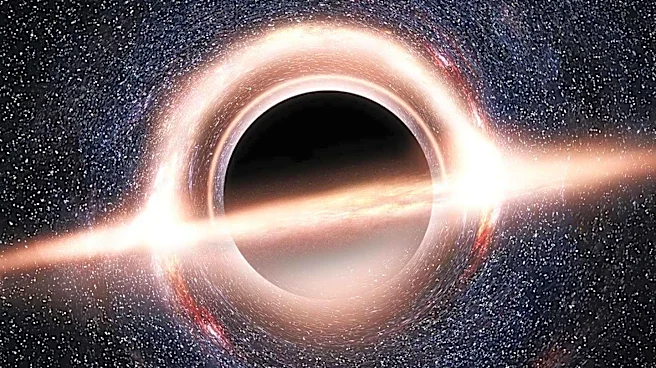
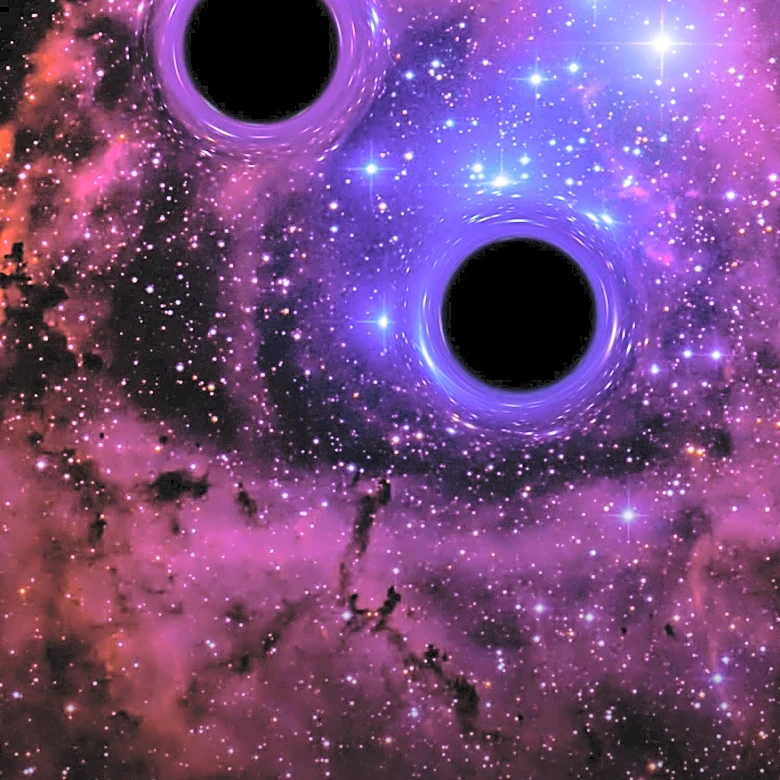
An international team of researchers, including Prof. Gilbert Weinstein of Ariel University, has definitively solved a 50-year-old mystery in astrophysics: whether multiple black holes can exist in a perfectly static equilibrium. The conclusive answer,
now mathematically proven, is no. Since Albert Einstein's theory of general relativity, black holes have been a subject of intense study. While 'no-hair theorems' established that an isolated, stable black hole is characterized by only its mass and angular momentum, the question of multiple black holes aligned on a common axis remained. The research, which involved an in-depth mathematical analysis of Einstein's vacuum equations, demonstrated that forces between more than one black hole in such a system cannot cancel each other out. There is always a net attractive force along their common axis of rotation, preventing them from remaining in a fixed, static state.
Why It's Important?
This breakthrough is a significant milestone in understanding the fundamental laws of the universe and closes a long-standing gap in the study of general relativity. For decades, the scientific community lacked definitive mathematical proof regarding the stability of multiple black hole systems. The new proof confirms that such equilibrium states are impossible, meaning that multiple black holes will inevitably interact dynamically, leading to changes like mutual collapse and merger. This deepens scientific understanding of the dynamics between some of the most powerful objects in space and refines theoretical models of black hole behavior. The resolution of this mystery provides a more accurate framework for astrophysicists studying gravitational waves, galaxy formation, and the evolution of the cosmos, where black hole interactions play a crucial role.
What's Next?
The definitive proof that multiple black holes cannot maintain a static equilibrium will likely influence future theoretical and observational astrophysics. Researchers will continue to refine models of black hole mergers and interactions, incorporating this new understanding. This could lead to more accurate predictions for gravitational wave events detected by observatories like LIGO, which are caused by merging black holes. The findings may also guide the search for and interpretation of data from systems containing multiple black holes, such as those at the centers of galaxies. The resolution of this long-standing theoretical problem could also inspire new questions and avenues of research into the complex interplay of gravity and spacetime in extreme cosmic environments.
Beyond the Headlines
The solution to this 50-year-old mystery underscores the power of mathematical physics in unraveling the universe's deepest secrets. It highlights how abstract theoretical work can have profound implications for our understanding of cosmic phenomena. The personal connection of Prof. Gilbert Weinstein, whose doctoral adviser first presented him with the mystery 40 years ago, illustrates the long-term dedication and intellectual lineage often involved in scientific breakthroughs. This discovery reinforces the dynamic nature of the universe, where even the most massive objects are constantly in motion and evolving, rather than existing in static perfection. It also serves as a testament to the ongoing quest for knowledge in fundamental physics, continually pushing the boundaries of what is known about space, time, and gravity.