





What's Happening?
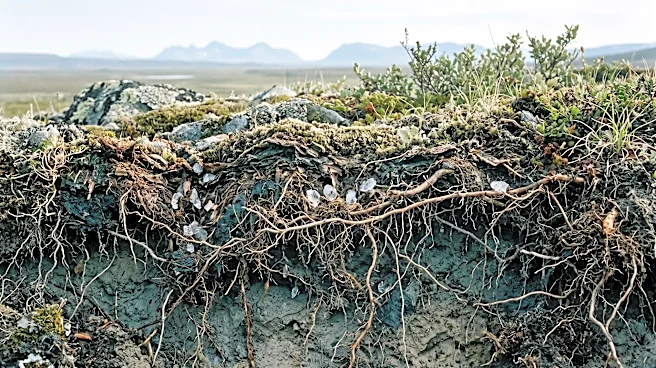
A new international review, led by researchers from Amherst College, The James Hutton Institute, and Umeå University, emphasizes the crucial role of plant roots in determining how Arctic tundra ecosystems respond to climate change. Arctic permafrost holds
an estimated 1,460 to 1,600 billion tons of organic carbon, approximately double the amount currently in the atmosphere. As this permafrost thaws due to rising temperatures, some of this carbon is released. While previous research has focused on above-ground changes like shrub growth and 'Arctic greening' for carbon absorption, this study argues that subterranean root processes and their surrounding soil environment are equally vital in determining whether these ecosystems act as carbon sources or sinks. The review, which integrated data from eight other research organizations, found that increasing temperatures and permafrost thawing can alter root productivity, depth, seasonal growth patterns, and plant-soil interactions. Roots can either help sequester carbon by supporting plant growth or stimulate microbes that release greenhouse gases like carbon dioxide and methane.
Why It's Important?
This research is critical for improving global climate models and understanding the future trajectory of climate change. The Arctic is one of the fastest-warming regions on Earth, and the processes occurring beneath its soil surface have significant implications for global climate. If Arctic ecosystems become net carbon sources, releasing vast amounts of stored carbon, it could accelerate global warming. Conversely, if they act as carbon sinks, they could help mitigate climate change. The study refines the understanding of Arctic tundra, moving beyond the previous assumption of it being a simple carbon sink. By highlighting the dual role of plant roots—both in locking carbon into soils and stimulating microbes that release greenhouse gases—the findings suggest that subterranean biological shifts could fundamentally alter global climate predictions. This improved understanding is essential for policymakers to assess environmental risks and develop effective mitigation strategies.
What's Next?
The scientific community plans to continue coordinating Arctic research efforts, particularly leading up to the 5th International Polar Year scheduled for 2032-2033. The researchers involved in this review are urging a new focus on soil processes to better understand and potentially mitigate against runaway climate change. Future research will need to delve deeper into the complex interactions between plant roots, soil microbes, and thawing permafrost to provide more accurate climate predictions. This ongoing research will be crucial for refining climate models and informing global policy decisions regarding climate change. The findings underscore the need for continued investment in subterranean Arctic research to fully grasp the implications of a warming Arctic.
Beyond the Headlines
The study's emphasis on 'what happens out of sight' in the Arctic highlights a broader challenge in environmental science: the complexity of interconnected ecological systems. The dual nature of plant roots—their capacity to both sequester and release carbon—illustrates that environmental impacts are rarely straightforward. This complexity necessitates a holistic approach to climate research, moving beyond surface-level observations to understand the intricate biological and chemical processes occurring beneath the Earth's surface. The ethical implication is that human activities are triggering changes in remote ecosystems with potentially cascading and unpredictable global consequences. Legally and culturally, this research reinforces the urgency for international cooperation and policy frameworks that address climate change, recognizing that local changes in the Arctic have global repercussions, affecting everything from sea levels to weather patterns worldwide.