



What's Happening?
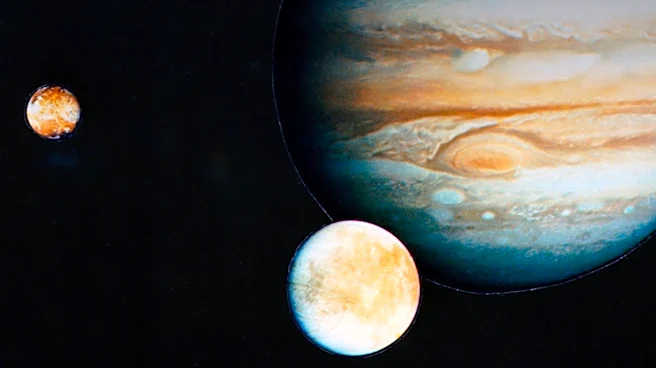
In 1610, Galileo Galilei used a telescope to observe four moons orbiting Jupiter, challenging the long-held belief that all celestial bodies revolved around Earth. This discovery provided tangible evidence against the geocentric model, which had dominated
scientific thought for centuries. Galileo's observations, published in 'Sidereus Nuncius,' marked a significant shift in astronomy, moving it from theoretical speculation to empirical science. The moons, later named Io, Europa, Ganymede, and Callisto, demonstrated that not all celestial bodies orbited Earth, supporting the heliocentric model proposed by Copernicus.
Why It's Important?
Galileo's discovery was pivotal in the scientific revolution, fundamentally altering humanity's understanding of the universe. It challenged the authority of the Church and traditional scientific beliefs, paving the way for modern astronomy. By providing observable evidence, Galileo's work shifted the focus from philosophical debate to empirical observation, setting a precedent for scientific inquiry. This shift had profound implications for science and society, encouraging a more evidence-based approach to understanding the natural world and diminishing the influence of dogma in scientific discourse.
Beyond the Headlines
Galileo's observations not only advanced scientific knowledge but also highlighted the power of technology in expanding human understanding. The use of the telescope as a tool for discovery underscored the importance of technological innovation in scientific progress. This event also illustrated the tension between science and established authority, a dynamic that continues to influence scientific and cultural developments today. Galileo's work serves as a reminder of the transformative potential of challenging established norms and the importance of evidence in shaping our understanding of the universe.