


What's Happening?
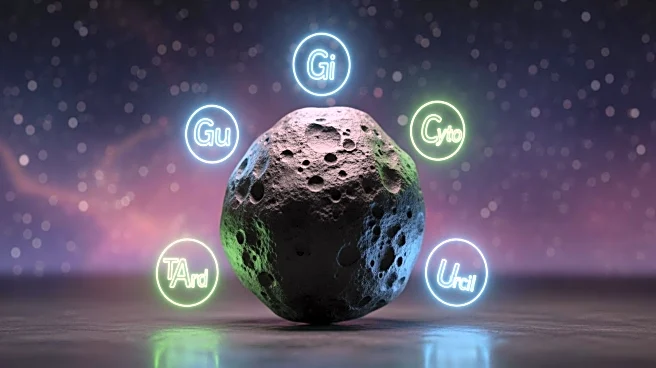
A recent study has confirmed the presence of all five fundamental nucleobases in samples from the asteroid Ryugu. These nucleobases, which are the molecular 'letters' of life, were detected in samples returned by Japan Aerospace Exploration Agency's (JAXA)
Hayabusa2 mission in 2020. The discovery was published in Nature Astronomy by a team of Japanese scientists. The nucleobases found include adenine, guanine, cytosine, thymine, and uracil, which are essential components of DNA and RNA. This finding suggests that the chemical ingredients necessary for life may have been widespread throughout the early solar system. The Ryugu samples, collected in space and protected from Earth's contamination, provide a pristine view of ancient solar system chemistry, offering clues about the formation and distribution of life's building blocks across the cosmos.
Why It's Important?
The discovery of all five nucleobases in the Ryugu samples is significant as it supports the theory that the building blocks of life could have formed in space and been delivered to Earth via asteroids. This finding enhances our understanding of the chemical processes that may have contributed to the origin of life on Earth. By studying these nucleobases, scientists can reconstruct the chemical history of primitive asteroids, providing insights into the early solar system's conditions. The research also aligns with previous findings from other meteorites and NASA's mission to asteroid Bennu, suggesting a commonality in the chemical makeup of these celestial bodies. This could have implications for the search for life beyond Earth, as it indicates that the essential components for life might be more common in the universe than previously thought.
What's Next?
Future research will likely focus on comparing the chemical signatures of Ryugu with other asteroids and meteorites to better understand the diversity of prebiotic chemistry in the solar system. Scientists may also explore the role of ammonia and other molecules in influencing the formation of nucleobases. Additionally, ongoing and future space missions could aim to collect more pristine samples from other asteroids to further investigate the distribution of life's building blocks in space. These efforts will contribute to refining our models of solar system formation and the potential for life elsewhere in the universe.