



What's Happening?
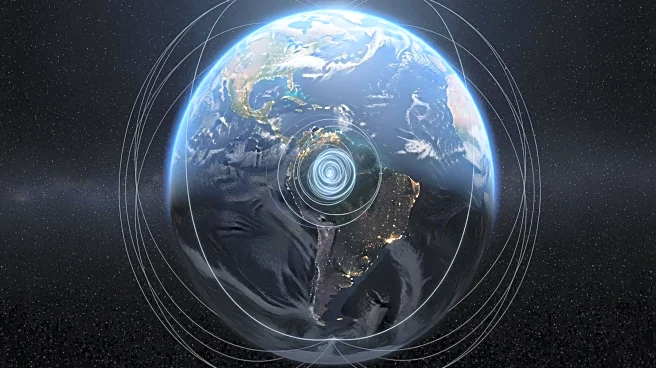
Research based on data from the European Space Agency's Swarm satellite constellation has revealed that the South Atlantic Anomaly, a weak spot in Earth's magnetic field, has expanded to cover an area nearly half the size of Europe since 2014. This anomaly,
located over the South Atlantic Ocean, poses significant risks to satellites and space operations due to increased radiation exposure. The study highlights that the magnetic field is weakening more rapidly in certain regions, particularly southwest of Africa, due to complex processes occurring in Earth's core. These findings are crucial for understanding the dynamic nature of Earth's magnetism and its implications for space safety.
Why It's Important?
The expansion of the South Atlantic Anomaly has significant implications for satellite operations and space exploration. Increased radiation levels in this region can lead to malfunctions and damage to satellites, affecting communication, navigation, and Earth observation services. Understanding the changes in Earth's magnetic field is also vital for predicting space weather events that can impact technological infrastructure on Earth. The research underscores the importance of continuous monitoring and analysis of Earth's magnetic field to mitigate potential risks and enhance the resilience of space-based systems.
What's Next?
The ongoing research into the South Atlantic Anomaly and Earth's magnetic field will likely continue, with scientists using data from the Swarm mission to refine models and improve predictions. Future studies may focus on the underlying causes of the anomaly's expansion and its potential long-term effects. As the Swarm satellites continue to provide valuable data, there may be opportunities to develop new technologies and strategies to protect satellites from increased radiation exposure. Additionally, the findings could inform international efforts to enhance space weather forecasting and preparedness.