






What's Happening?
The foreign policy approach of President Trump has been criticized for undermining efforts towards a 'prosperous, economically integrated, and secure hemisphere' in the Western Hemisphere. While some commentators, like Ryan C. Berg and Joseph Ledford,
have argued for a 'Western Hemisphere Pivot' under the Trump administration, the source suggests that actions taken by the U.S. have eroded trust and hindered integration. Specific examples cited include the 'arrest' of Nicolas Maduro, which resulted in dozens of deaths, Operation Southern Spear's anti-drug efforts leading to hundreds of casualties, and the naval blockade of Cuba. These actions are seen as prioritizing U.S. goals over relationships of mutual respect, a pattern that has historically characterized U.S. interactions with Latin American countries, with the exception of Franklin Roosevelt's Good Neighbor Policy. The current administration's policies, such as raising tariffs on close trading partners like Canada and Mexico and deporting immigrants, are viewed as counterproductive to regional integration.
Why It's Important?
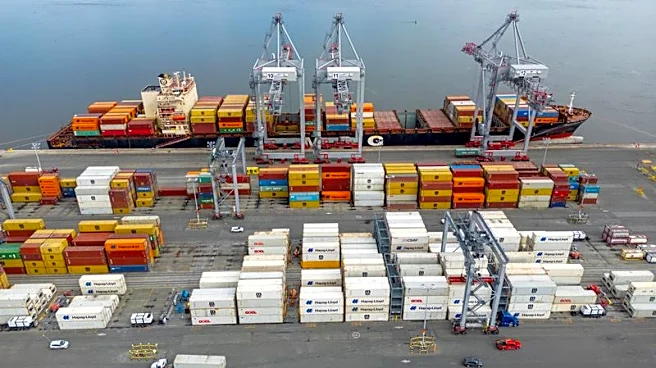
The potential for a truly integrated Western Hemisphere holds significant importance for the U.S. and its neighbors. Economically, integration could provide American firms with new opportunities for specialization and scale, helping the U.S. maintain its economic edge against rising global powers like China. Proximity already makes Canada and Mexico the largest trading partners of the U.S., and further integration could enhance this. Strategically, an integrated economy relying on regional resources would be more resilient to disruptions in global trade, especially as the dominance of the U.S. Navy wanes and potential conflicts in other parts of the world could impact supply chains. Beyond economics and strategy, integration could also set a floor for human rights and political freedom, potentially reducing refugee crises and allowing for easier formal migration, which could benefit both the U.S. and its neighbors. The current U.S. approach, however, is seen as eroding the trust necessary for such integration, making it difficult for other nations to view the U.S. as a benign partner.
What's Next?
Achieving true hemispheric integration would require a significant shift in U.S. foreign policy, starting with rebuilding trust. This would likely involve the U.S. signing binding agreements on the use of military force, which it has historically been reluctant to do, to reassure Latin American and Caribbean leaders about U.S. intentions regarding their sovereignty. Economically, reversing policies like the withdrawal from the USMCA/NAFTA and streamlining cross-border trade would be critical first steps. For middle- and lower-income economies, more than just free trade would be necessary; direct, targeted subsidies from wealthier to less wealthy countries, similar to those seen in the European Union, could finance projects without the burden of repayment, making integration more attractive. The most ambitious step would be to work towards hemispheric freedom of movement, allowing people to travel, live, and work across borders, which would improve efficiencies, benefit university systems and cultural institutions, and strengthen families. These changes would require overcoming significant political challenges within the U.S., including a shift away from nativist and protectionist sentiments.
Beyond the Headlines
The deeper implications of the current U.S. foreign policy in the Western Hemisphere extend to the fundamental nature of international relations and the U.S.'s role as a global leader. The erosion of trust, stemming from perceived unilateral actions and a lack of respect for sovereignty, could have long-term consequences for U.S. influence and its ability to forge meaningful alliances. The comparison to European integration highlights the ethical and cultural dimensions of building a cohesive region; it requires a shared vision and a willingness to prioritize collective benefits over narrow national interests. The current approach risks isolating the U.S. from its closest neighbors, potentially pushing them towards other global powers or fostering regional instability. The long-term shift required is not just in policy, but in the U.S. public's perception of itself as part of a larger hemisphere, moving beyond a purely nationalistic outlook to embrace a more integrated identity. This cultural shift is crucial for sustaining any future efforts towards genuine hemispheric cooperation and rebuilding American diplomatic and economic potential.