



What's Happening?
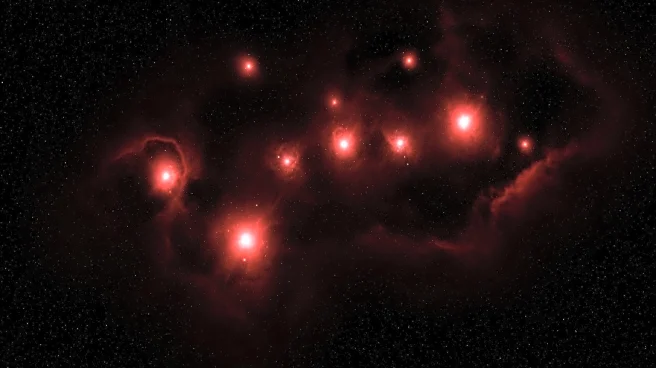
The James Webb Space Telescope (JWST) has discovered mysterious objects known as 'Little Red Dots' that may serve as nurseries for massive black holes. These objects, identified through deep extragalactic surveys, are thought to be direct-collapse black holes formed
from collapsing gas clouds rather than from the remnants of stars. This discovery could provide insights into the early formation of supermassive black holes, which have been observed as early as 500 million years after the Big Bang. The research, led by Elia Cenci from the University of Geneva, suggests that these direct-collapse black holes could act as 'heavy seeds,' allowing them to grow into supermassive black holes more quickly than previously theorized.
Why It's Important?
The identification of 'Little Red Dots' as potential nurseries for direct-collapse black holes could solve a significant mystery in astrophysics regarding the rapid formation of supermassive black holes in the early universe. Understanding this process is crucial as it challenges the traditional view that such black holes form over billions of years through mergers. The findings could reshape theories about the conditions necessary for black hole formation and provide a new perspective on the evolution of galaxies. This research highlights the JWST's capability to uncover phenomena that were previously undetectable, offering a deeper understanding of cosmic evolution.
What's Next?
Further observational evidence is needed to confirm the role of 'Little Red Dots' as direct-collapse black hole nurseries. This will require higher-resolution astronomical data and more comprehensive spectral coverage to better understand the dynamics and physical state of these objects. Researchers, including Cenci and her team, are conducting high-resolution simulations to explore the conditions under which these black holes form. These efforts aim to provide additional insights into the relationship between 'Little Red Dots' and direct-collapse black holes, potentially leading to a more complete understanding of their role in the universe's early history.