



What's Happening?
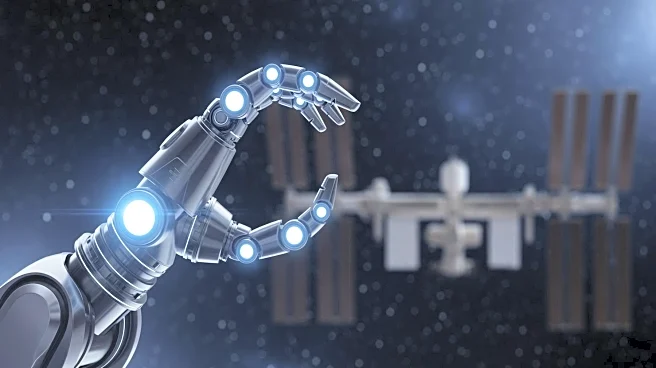
Stanford researchers have successfully used artificial intelligence to pilot a free-flying robot aboard the International Space Station (ISS). The team worked with NASA's Astrobee robot to demonstrate how a machine-learning system can plan safe routes
through the ISS's crowded modules more efficiently than existing methods. This development addresses a significant challenge in space robotics: moving quickly and safely with limited computing power and minimal human input. The AI model was trained on thousands of previously computed paths, allowing it to start each new plan with an informed 'warm start,' significantly reducing computation time. This approach was tested in orbit, where the AI-generated routes were 50% to 60% faster to compute than conventional plans.
Why It's Important?
The use of AI in navigating robots on the ISS represents a significant advancement in space exploration technology. This development could pave the way for more autonomous space missions, reducing the need for human intervention in routine tasks. As space missions become more frequent and extend further from Earth, the ability to operate autonomously will be crucial. This technology could allow robots to handle inspections, logistics, and scientific tasks, freeing astronauts to focus on more critical work. The success of this AI application demonstrates the potential for increased efficiency and safety in space operations, which is essential for future missions to the moon, Mars, and beyond.
What's Next?
The successful trial of AI navigation on the ISS sets the stage for broader applications of this technology in future space missions. The research team suggests that similar AI-guided planning could be used for tasks on missions to the moon and Mars. As space exploration continues to evolve, the integration of AI could become a standard practice, enhancing the capabilities of robotic systems in space. This development also highlights the importance of continued research and innovation in AI and robotics to support the growing demands of space exploration.