



What's Happening?
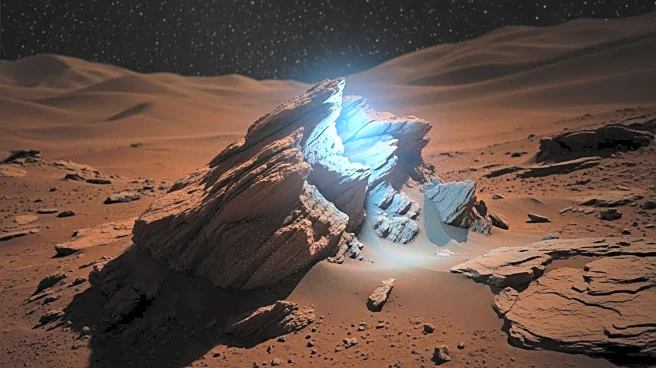
NASA's Curiosity rover has captured a rare nighttime image of the Martian surface using LED lights on its robotic arm. This image, taken on December 6, 2025, showcases the surface of Mars in a region known for its geologic formations called boxwork. The
LED lights, part of the Mars Hand Lens Imager (MAHLI), were used to illuminate a drill hole in a rock target named 'Nevado Sajama.' This technique allows scientists to examine the rock's composition and layering, providing valuable insights into Mars' geological history.
Why It's Important?
The use of nighttime imaging by the Curiosity rover represents a significant advancement in planetary exploration techniques. By illuminating the Martian surface, scientists can gather detailed information about the planet's geology, which is crucial for understanding its history and potential for past life. These findings contribute to the broader goals of Mars exploration, including the search for signs of life and the preparation for future human missions to the planet.
Beyond the Headlines
The ability to conduct nighttime imaging on Mars opens new possibilities for scientific research, allowing for the study of features that are not visible during the day. This technique could be applied to other planetary missions, enhancing our understanding of the solar system. Additionally, the data collected by Curiosity supports the development of technologies and strategies for future Mars missions, including those involving human exploration.