
What's Happening?
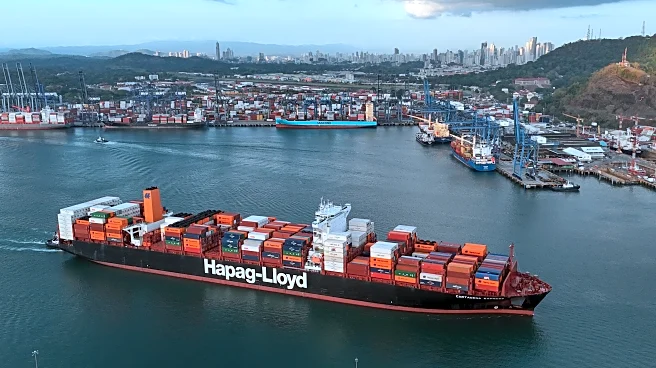
Panama's President José Raúl Mulino has declared that the country will not be intimidated by China following a Supreme Court ruling that deemed a concession held by Hong Kong's CK Hutchison Holdings in the Panama Canal unconstitutional. The ruling aligns
with U.S. interests, as President Donald Trump seeks to limit Chinese influence over the strategic waterway. In response, China has warned Panama of potential repercussions. CK Hutchison Holdings has initiated arbitration proceedings against Panama, while the Panamanian government plans to transition port operations to a local subsidiary of A.P. Moller-Maersk once the concession is formally ended.
Why It's Important?
The legal battle over the Panama Canal concession underscores the geopolitical tensions between the U.S. and China, with Panama caught in the middle. The canal is a critical global trade route, and control over its operations has significant strategic implications. The U.S. aims to curtail Chinese influence in the region, while China seeks to maintain its foothold. The outcome of this dispute could affect international trade dynamics and influence future infrastructure investments in the region. Panama's stance reflects its commitment to sovereignty and could set a precedent for other countries facing similar pressures.
What's Next?
As arbitration proceedings unfold, the situation remains fluid, with potential impacts on the broader $23 billion sale of CK Hutchison's global ports. The transition of port operations to A.P. Moller-Maersk will be closely monitored, as it could affect trade flows and logistics in the region. The geopolitical implications of this dispute may influence future U.S.-China relations and impact Panama's diplomatic and economic strategies. Stakeholders will be watching for any shifts in policy or alliances that could arise from this high-stakes legal and political confrontation.