






What's Happening?
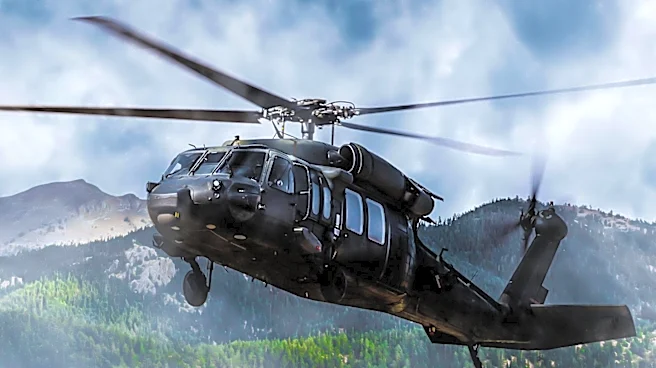
The UH-60 Black Hawk, developed by Sikorsky Aircraft, has been a foundational asset for the U.S. Army for nearly five decades, serving as a versatile medium-lift utility helicopter. Originating from the Utility Tactical Transport Aircraft System (UTTAS)
competition in 1972, it was designed to replace the UH-1 Huey, offering enhanced payload capacity, range, and survivability. Since its introduction in 1979, the Black Hawk has evolved through numerous variants, including the UH-60A, UH-60L, UH-60M, and specialized versions like the HH-60M MEDEVAC and MH-60 for special operations. Its adaptability allows it to perform a wide array of missions, from troop transport and air assault to medical evacuation, search and rescue, and humanitarian assistance. The helicopter's design incorporates twin engines, a four-blade rotor system, and a crashworthy airframe, contributing to its reliability and operational success in various global conflicts and disaster relief efforts.
Why It's Important?
The UH-60 Black Hawk's enduring service highlights its critical role in U.S. military operations and global defense strategies. Its continuous modernization and adaptability have allowed it to remain relevant across diverse combat environments and humanitarian crises, making it a workhorse for the U.S. Army and over 35 other nations. The helicopter's proven operational maturity, established maintenance infrastructure, and ongoing upgrade programs ensure its continued effectiveness alongside emerging technologies. This longevity underscores the importance of robust, adaptable military platforms that can evolve to meet changing defense priorities. The Black Hawk's success also demonstrates the strategic value of investing in systems that offer versatility and survivability, directly impacting troop deployment capabilities, casualty evacuation, and overall mission success in complex operational theaters worldwide.
What's Next?
Despite the U.S. Army's pursuit of next-generation rotorcraft through the Future Vertical Lift initiative, the UH-60 Black Hawk is projected to remain in frontline service for many more years. Ongoing upgrades are focused on improving its digital connectivity, navigation and sensor systems, survivability, and engine performance. These enhancements aim to ensure the Black Hawk can operate effectively alongside newer technologies and within increasingly networked battlefields. Sikorsky is also exploring autonomous configurations by integrating its MATRIX autonomy system into the platform, indicating a future where the Black Hawk could potentially operate with reduced human intervention. This continued investment in modernization suggests that the Black Hawk will maintain its status as a defining utility helicopter, even as newer platforms gradually enter service, ensuring its operational relevance for the foreseeable future.
Beyond the Headlines
The UH-60 Black Hawk's nearly five-decade tenure in military service reflects more than just its technical capabilities; it represents a significant chapter in military aviation doctrine and technological evolution. Its iconic status, partly cemented by events like the 'Black Hawk Down' incident, has shaped public perception of military helicopters and their role in modern warfare. The continuous adaptation of the Black Hawk, from analog to digital cockpits and potential autonomous flight, illustrates the relentless pace of technological advancement in defense and the strategic imperative to extend the life of proven assets. This evolution also highlights the complex balance between developing entirely new platforms and upgrading existing ones, a decision often driven by cost, operational readiness, and the need to maintain a technological edge. The Black Hawk's story is a testament to engineering resilience and strategic foresight in military procurement and development.