






What's Happening?
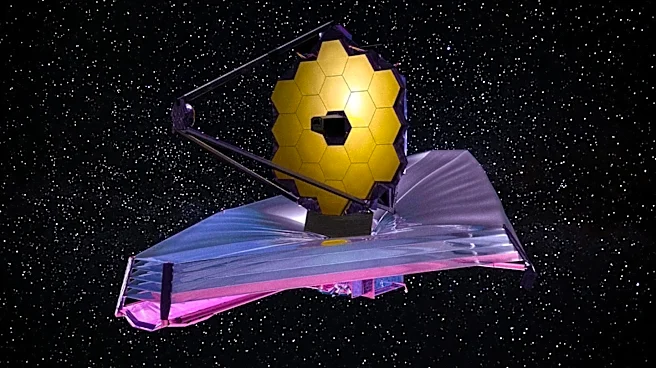
A new study, based on observations from the James Webb Space Telescope (JWST), proposes an explanation for the unusually rapid growth of giant black holes in the early universe. Astronomers have long been puzzled by the existence of black holes weighing
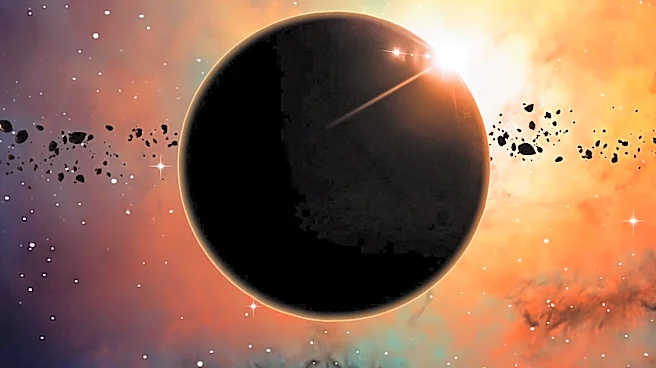
billions of solar masses just 700 million years after the Big Bang. The research describes a young black hole enveloped in gas so dense that the entire object shines like a single enormous star, a phenomenon dubbed a 'black hole star.' This particular object, named 'MoM-BH*-1,' is the earliest example found, with its light traveling for 13 billion years. The study suggests that a thick envelope of gas can trap the light emitted by matter falling into the black hole, preventing the outward push that normally limits growth. This allows gravity to dominate, enabling the black hole to grow beyond its usual feeding limit, a process known as super-Eddington accretion.
Why It's Important?
This discovery is important because it offers a potential solution to a long-standing cosmological mystery: how supermassive black holes achieved their immense sizes so quickly after the Big Bang. Current models struggle to explain this rapid growth, as the light from accreting matter typically creates an outward pressure that limits how fast a black hole can consume material. The 'black hole star' model, where dense gas traps this light, provides a mechanism for accelerated growth. This could significantly revise our understanding of early galaxy formation and evolution, as supermassive black holes are known to play a crucial role in shaping their host galaxies. If this mechanism is widespread, it would imply that the early universe had conditions conducive to such rapid black hole growth, influencing the distribution of matter and the development of cosmic structures.
What's Next?
The research team plans to conduct further studies to confirm the prevalence of these 'black hole stars' and their role in early universe black hole growth. This will involve analyzing larger statistical samples and developing more sophisticated computer simulations to reproduce the observed conditions. Astronomers will also focus on measuring the composition and wind speeds of the gas envelopes surrounding these objects. The team is actively designing specific surveys to identify more such objects, which will help determine if 'MoM-BH*-1' is a rare anomaly or representative of a common class of objects in the early universe. The findings could also lead to a re-evaluation of mass estimates for other 'little red dots' observed by JWST, which were previously thought to be baby quasars.
Beyond the Headlines
The concept of a 'black hole star' fundamentally alters our perception of black hole visibility and interaction with their environment. Instead of being invisible gravitational sinks, these objects, cloaked in dense gas, could have been luminous beacons in the early universe, potentially influencing the ionization of the intergalactic medium. This discovery also highlights the power of the James Webb Space Telescope in pushing the boundaries of observational astronomy, revealing phenomena previously undetectable. The ethical implications revolve around the scientific pursuit of knowledge, as understanding these extreme cosmic phenomena helps us piece together the universe's origins and evolution, impacting our philosophical understanding of existence and the laws of physics. It underscores the continuous human endeavor to explore and comprehend the cosmos.