







What's Happening?
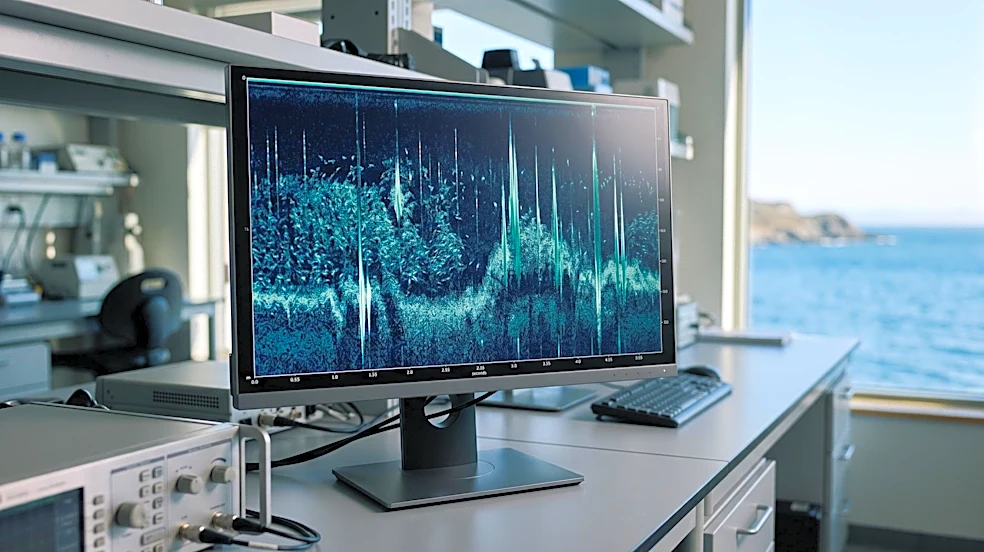
Researchers have developed an improved AI framework based on RT-DETR for detecting and counting shrimp in EK80 acoustic echograms. This new method addresses challenges such as the small size of shrimp, their dense distribution, and interference from background
noise in underwater acoustic imaging. The framework incorporates several key modifications: a high-resolution P2 feature level to preserve fine spatial details of small targets, an Efficient Multi-scale Attention (EMA) mechanism to enhance shrimp-related acoustic responses while suppressing background noise, and optimized loss functions (Focal Loss and Wise-IoU v3) to improve classification accuracy and bounding-box localization. Experimental results show that the proposed model significantly outperforms the baseline RT-DETR, achieving higher precision, recall, and mean average precision (mAP). Specifically, the model achieved a mean Precision of 0.834, Recall of 0.841, mAP@50 of 0.844, and mAP@50:95 of 0.437, marking substantial improvements over the baseline. The framework also integrates DeepSORT for multi-object tracking, enabling automated shrimp counting with an average accuracy of 83.32%.
Why It's Important?
This advancement is crucial for environmental monitoring and the operational safety of coastal infrastructure, particularly nuclear power plants. Large aggregations of shrimp can clog cooling-water intake systems, leading to power reductions, shutdowns, and operational risks. Accurate and automated monitoring of shrimp abundance provides critical data for biological risk assessment and safety management. The improved AI framework offers a non-invasive and efficient method for continuous monitoring, reducing the need for manual interpretation of complex acoustic data. This can lead to earlier warnings of potential blockages, allowing for proactive measures to be taken, thereby preventing costly disruptions and ensuring the continuous operation of essential facilities. Furthermore, the methodology could be adapted for monitoring other small aquatic organisms, contributing to broader ecological studies and fisheries management.
What's Next?
Future research will focus on expanding the dataset to include various shrimp species, different water depths, varying target densities, and diverse acoustic environments to enhance the model's generalization capabilities. Researchers plan to incorporate temporal information and multi-frequency acoustic features into the detection and tracking framework to further improve the discrimination of weak biological echoes from background scattering. Additionally, more robust trajectory association methods and adaptive tracking strategies will be investigated to reduce identity fragmentation and counting errors, which are common in dense and dynamic underwater environments. Efforts will also be directed towards domain adaptation and cross-environment validation to improve the model's transferability from controlled experimental conditions to practical, real-world monitoring systems, such as those at cooling-water intake facilities. Further optimization for deployment on resource-constrained edge devices will also be considered to facilitate real-time, long-duration monitoring.
Beyond the Headlines
The development of this advanced AI framework signifies a broader trend in leveraging artificial intelligence for ecological monitoring and industrial safety. Beyond immediate applications in nuclear power plant safety, this technology has implications for marine conservation, aquaculture, and fisheries management. The ability to accurately count and track small marine organisms in challenging underwater environments opens doors for better understanding population dynamics, migration patterns, and the impact of environmental changes on aquatic ecosystems. Ethically, this technology promotes more sustainable practices by providing data-driven insights for resource management, potentially reducing the need for more invasive survey methods. Legally, such monitoring systems could become standard requirements for industrial operations in coastal areas, ensuring compliance with environmental protection regulations. Culturally, it represents a step towards integrating advanced technological solutions into environmental stewardship, fostering a more proactive and data-informed approach to managing human-environment interactions.