




What's Happening?
A Martian meteorite, Teghaza 001, discovered in the Sahara Desert in 2022, has been identified as one of the oldest known pieces of Mars, dating back over 4.1 billion years. Yang Liu, a geologist at NASA's Jet Propulsion Laboratory, initially hesitated
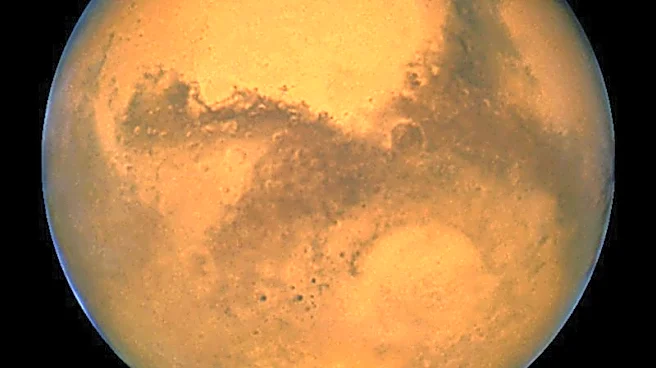
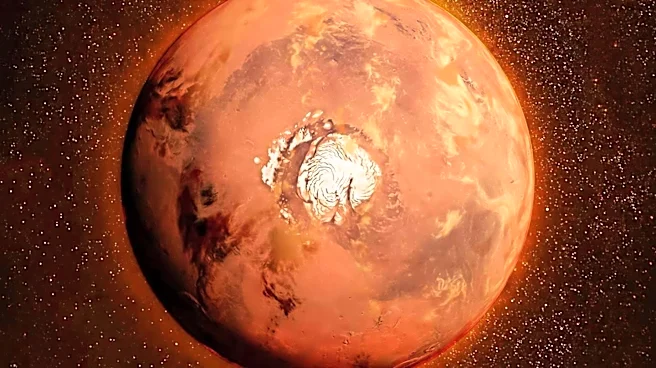
to study the rock due to its common appearance but found its unique texture and minerals warranted further investigation. The meteorite preserves a snapshot of Mars from more than 4 billion years ago, less than 500 million years after the planet's formation. Its mineral composition indicates that water locked within its structure had already lost much of its lighter hydrogen to space, suggesting Mars began losing its water early in its history. This discovery provides crucial context for understanding the potential for early life on Mars, indicating that any biology would have faced a drying world. Unlike most Martian meteorites, which formed from magma less than 2.4 billion years ago and belong to specific families like shergottites, nakhlites, and chassignites, Teghaza 001's unique mineralogy and chemistry set it apart, making it the first known sample of Martian crust from a previously unsampled region.
Why It's Important?
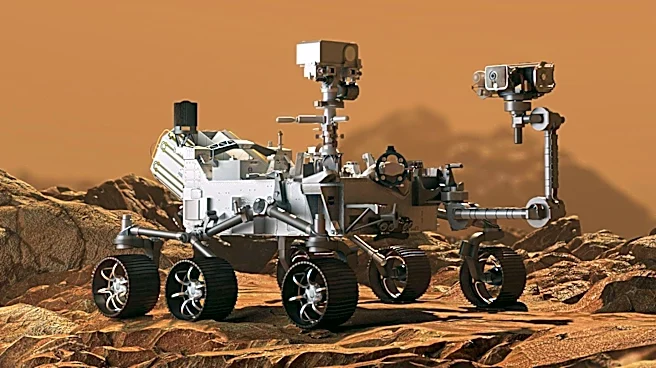
This meteorite is considered a 'Rosetta Stone for Mars' because it offers an unprecedented look into the planet's early history, particularly its crust formation and ancient water cycle. Its age, predating almost all surviving Earth rocks, provides scientists with direct evidence of conditions on Mars over 4 billion years ago. The chemical fingerprint of water within the meteorite, specifically the enrichment of deuterium, indicates that Mars was losing water to space very early on. This finding is significant for astrobiology, as it suggests that even if life emerged on early Mars, it would have contended with a progressively arid environment. The unique composition of Teghaza 001, distinct from other known Martian meteorites, implies it originated from a part of Mars's crust that has never been sampled before, offering new insights into the planet's geological diversity and evolution. The data from this meteorite can help validate observations made by orbiters like NASA's Mars Reconnaissance Orbiter, which has identified similar mineral compositions in the heavily cratered southern highlands of Mars.
What's Next?
The study of Teghaza 001 is expected to pave the way for more precise dating of other Martian meteorites and potentially samples returned from other celestial bodies. Scientists utilized advanced dating techniques, including tracking radioactive rubidium's transformation into strontium, to determine the meteorite's age. This methodology could be applied to future extraterrestrial samples, enhancing our understanding of planetary formation timelines. Further analysis of Teghaza 001's mineralogy and isotopic composition will likely continue to refine our understanding of Mars's early climate, water cycle, and geological processes. The identification of 13 specific locations on Mars whose minerals and chemistry are consistent with the meteorite could guide future Mars missions, potentially influencing landing site selections for rovers or sample return missions aimed at collecting similar ancient crustal material. The ongoing research will contribute to the broader scientific debate about the habitability of early Mars and the conditions necessary for the emergence of life.
Beyond the Headlines
The discovery of Teghaza 001 extends beyond its immediate scientific implications, touching upon the broader narrative of planetary evolution and the search for extraterrestrial life. The meteorite's evidence of an early drying Mars challenges previous assumptions about a potentially long-lived wet environment, suggesting that the window for sustained liquid water and thus potential life might have been shorter or more intermittent than once thought. This shifts the focus of astrobiological research towards understanding how life might adapt to or emerge in more challenging, arid conditions. Furthermore, the rarity of Martian meteorites, with only about 0.5% of all found meteorites originating from Mars, underscores the immense value of each new sample. Teghaza 001 represents a tangible link to the deep past of another planet, offering a unique opportunity to study planetary processes that occurred billions of years ago, processes that are largely erased on Earth due to tectonic activity. This 'Rosetta Stone' not only deciphers Mars's past but also provides a comparative planetology framework for understanding Earth's own early history.