



What's Happening?
Scientists have successfully recreated the chirps and high-pitched sounds of Jurassic insects, simulating a 165-million-year-old soundscape. Thorin Jonsson from the Institute of Biology at the University of Graz, along with colleagues from various international
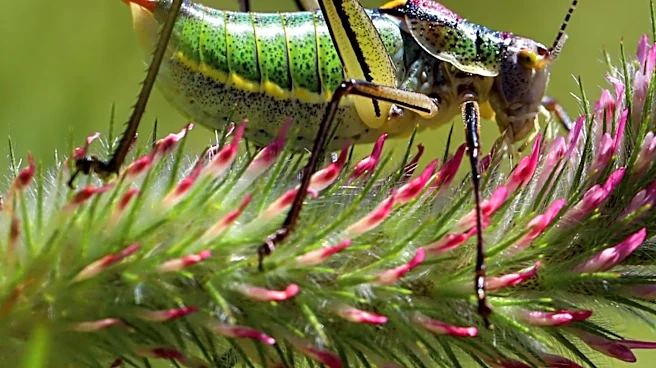
universities, published their findings in the journal PNAS. By analyzing exceptionally well-preserved fossils of nine different grasshopper species from the Middle Jurassic period in Inner Mongolia, researchers were able to reconstruct the pitches and musical units of their mating calls. Insects from the order Orthoptera, such as crickets and grasshoppers, produce sounds through 'stridulations' by rubbing wing structures. The detailed imprints on the fossilized wings provided precise information, allowing for AI-assisted evaluations to determine the specific frequencies of these ancient sounds.
Why It's Important?
This groundbreaking research significantly enhances our understanding of ancient ecosystems and evolutionary biology, particularly in the U.S. and globally. It provides the oldest evidence of sound ever reproduced, offering a unique auditory window into the Jurassic period beyond the roars of dinosaurs. For evolutionary biologists, the discovery that one species, *Sigmaboilus peregrinus*, communicated in the ultrasonic range millions of years before the existence of bats challenges previous theories about the evolutionary pressure for such high frequencies. This suggests alternative reasons for ultrasonic vocalization, such as predator avoidance or mating strategies to cut through environmental noise. This insight into ancient acoustic diversity helps scientists better understand the co-evolution of species and their sensory environments, impacting fields from paleontology to bioacoustics.
What's Next?
The team will continue to explore the implications of their findings for the evolutionary biology of Orthoptera, investigating further the reasons behind ultrasonic vocalizations in the absence of bat predators. This could involve more detailed analyses of the fossil record and comparative studies with modern insect species. The methodology, which combines paleontological analysis with AI-assisted reconstruction, could be applied to other fossilized sound-producing organisms, potentially revealing more about ancient soundscapes. This research may also inspire new approaches to studying the sensory ecology of extinct animals and how they interacted with their environments, contributing to a more complete picture of prehistoric life.
Beyond the Headlines
Beyond its scientific implications, this research offers a profound connection to the deep past, allowing us to 'hear' a part of the world that existed millions of years ago. It highlights the incredible preservation capabilities of fossils and the power of modern technology, particularly AI, to unlock secrets from ancient life. This ability to reconstruct ancient sounds can foster a deeper appreciation for biodiversity and the complex evolutionary paths that have shaped life on Earth. It also serves as a reminder of the rich, often unseen, sensory dimensions of past ecosystems, encouraging a more holistic view of natural history and the intricate web of life.