



What's Happening?
An international study has discovered a surprising connection between quantum physics and artificial intelligence models. Researchers from the Institute of Nanotechnology of the National Research Council, the Italian Institute of Technology, and Sapienza
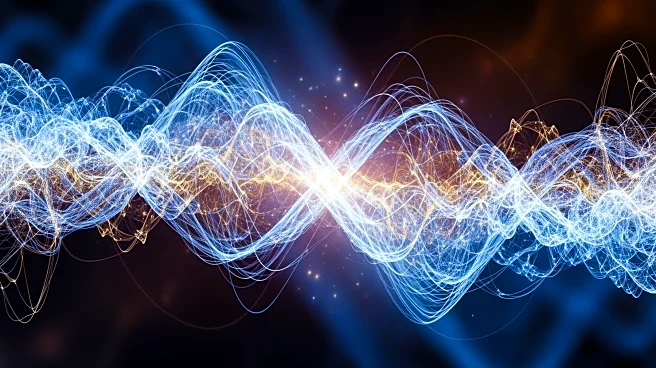
University of Rome have shown that identical photons in optical circuits can behave like a Hopfield Network, a model used to describe associative memory in the human brain. This research, published in Physical Review Letters, highlights how photons can act as 'neurons' in a quantum system, encoding and retrieving information through quantum interference. The study also identifies a fundamental limit to memory capacity, similar to biological systems, where increased data volume leads to a 'memory black-out' phase. This research opens new possibilities for using quantum optics in AI systems, potentially offering high performance with lower energy consumption.
Why It's Important?
The findings of this study have significant implications for the development of artificial intelligence and quantum computing. By demonstrating that photons can mimic neural networks, the research suggests a new approach to building AI systems that are more energy-efficient than current data centers. This could lead to advancements in AI technology, making it more sustainable and scalable. Additionally, the study provides a new platform for simulating complex physical systems, which could enhance our understanding of various natural and artificial phenomena. The research also connects to the broader field of theoretical physics, particularly in the study of spin glasses, and could influence future studies in both AI and quantum physics.