







What's Happening?
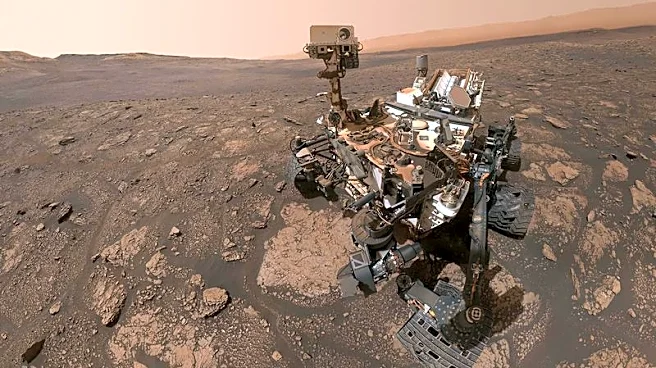
NASA's Curiosity rover has made a significant discovery on Mars, identifying the most diverse collection of organic molecules ever found on the planet. This includes seven compounds that have never been detected before. The findings were the result of a complex
'wet chemistry' experiment conducted in the Glen Torridon region of Gale Crater. Among the newly discovered molecules is a nitrogen heterocycle, a precursor to DNA and RNA, and benzothiophene, a sulfur-rich compound commonly found in meteorites. These organic molecules, while considered the building blocks of life, are not definitive proof of ancient biology. They could have been formed through geological processes or delivered by meteorites. However, the discovery indicates that the Martian subsurface can preserve complex organic material despite harsh radiation over billions of years, increasing the likelihood of finding signs of past life.
Why It's Important?
The discovery of these organic molecules on Mars is crucial as it enhances the understanding of the planet's potential to have supported life in the past. The presence of such complex organic compounds suggests that Mars had the necessary ingredients for life, similar to those on Earth. This finding could influence future missions to Mars, focusing on the search for past life and understanding the planet's habitability. It also provides valuable insights into the preservation of organic materials in extreme environments, which could inform the search for life on other planets. The implications extend to astrobiology and the study of life's origins, as these molecules are fundamental to biological processes.
What's Next?
Future Mars missions may prioritize areas where organic molecules have been found, using advanced technology to search for more complex compounds or direct evidence of past life. Scientists will likely conduct further analysis of the data collected by Curiosity to understand the formation and preservation of these molecules. This discovery may also prompt the development of new instruments and experiments designed to detect and analyze organic compounds on Mars and other celestial bodies. Collaboration between international space agencies could be enhanced to share findings and strategies for exploring Mars.