





What's Happening?
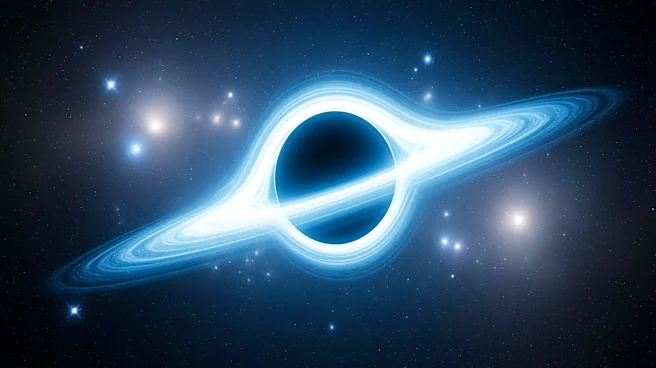
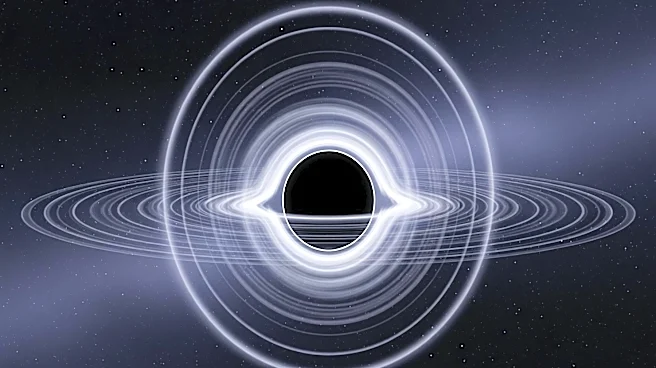
Researchers at Monash University have provided new evidence supporting the existence of a 'forbidden zone' in black hole masses, using data from the LIGO–Virgo–KAGRA network of observatories. This analysis suggests that stars with masses between 50 and
130 times that of the Sun end their lives in a type of supernova known as 'pair-instability', which completely destroys the star without leaving a black hole. The study, led by Hui Tong, analyzed the fourth Gravitational-Wave Transient Catalog (GWTC-4) and found a gap in the masses of secondary black holes in binary systems, specifically between 44 and 116 solar masses. This finding supports the theory that these stars explode in a manner that prevents black hole formation, a concept predicted in the 1960s but not directly observed until now.
Why It's Important?
This discovery is significant as it challenges existing theories of stellar evolution and black hole formation. By identifying a mass gap in secondary black holes, the research provides insights into the life cycle of massive stars and the conditions under which they explode. The findings could reshape our understanding of how black holes are formed and evolve, offering a new perspective on the cosmic events that lead to their creation. The use of gravitational wave data to infer these properties marks a shift from traditional electromagnetic observations, which struggle to detect such phenomena due to their rarity and distance. This advancement in gravitational wave astronomy could lead to a more comprehensive understanding of the universe's most energetic events.
What's Next?
Future gravitational wave observatories, expected to be operational in the 2030s, will enhance the detection capabilities for black hole mergers, potentially observing tens of thousands of events annually. This increased sensitivity will allow researchers to confirm the robustness of the identified mass gap and further explore the mechanisms behind black hole formation. Current detectors like LIGO will continue to refine their observations, reducing uncertainties and improving the overall picture of black hole mass distribution. These advancements will enable scientists to trace the evolution of stars and black holes across cosmic history, providing deeper insights into the universe's formative processes.