
What's Happening?
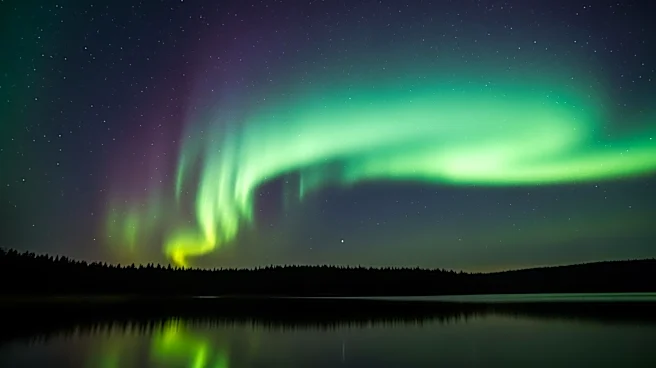
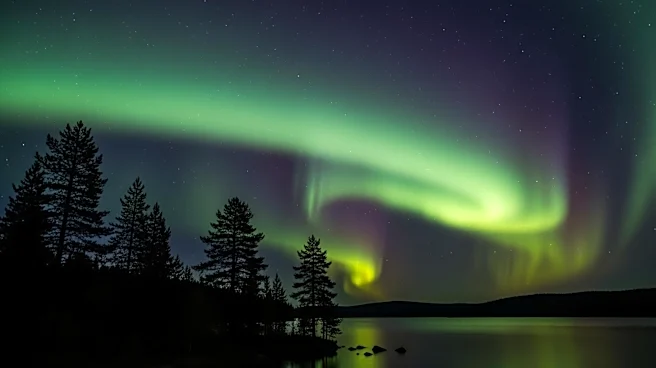
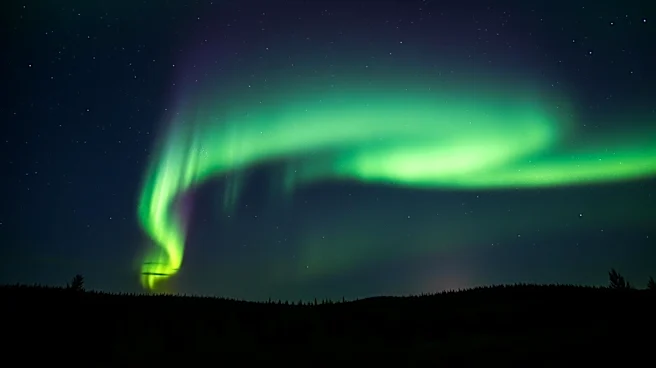
The National Oceanic and Atmospheric Administration (NOAA) has forecasted that the northern lights, or aurora borealis, may be visible from up to 20 northern U.S. states on the night of Saturday, April
18, into Sunday, April 19. This phenomenon is attributed to a G1 or G2 geomagnetic storm, which is expected to cause auroras on the northern horizon. The storm is driven by a high-speed stream of solar wind emanating from a coronal hole in the sun's outer atmosphere. The best viewing opportunities are anticipated in states such as Alaska, Washington, Idaho, Montana, North Dakota, South Dakota, Minnesota, Wisconsin, Michigan, and Maine. If the storm intensifies to a G2 level, states further south, including Oregon, Wyoming, Nebraska, Iowa, Illinois, Indiana, Ohio, New York, Vermont, and New Hampshire, may also witness the aurora.
Why It's Important?
The visibility of the northern lights across a significant portion of the United States is a rare and captivating event that draws public interest and engagement with natural phenomena. This occurrence not only provides a unique opportunity for residents in these states to experience a natural light show but also highlights the dynamic interactions between solar activity and Earth's magnetic field. Such events can increase public awareness and interest in space weather and its potential impacts on technology and communication systems. Additionally, the event may boost local tourism in areas where the aurora is visible, as enthusiasts and photographers travel to capture the spectacle.
What's Next?
As the geomagnetic storm progresses, NOAA will continue to monitor solar wind conditions and provide updates on aurora visibility. Enthusiasts are encouraged to use real-time aurora forecasts and apps to track visibility. The new moon on April 17 provides optimal dark sky conditions for viewing and photographing the aurora. If the storm's intensity increases, more states may experience visibility, prompting further interest and observation. The event also serves as a reminder of the importance of monitoring space weather, which can have broader implications for satellite operations and communication systems.