



What's Happening?
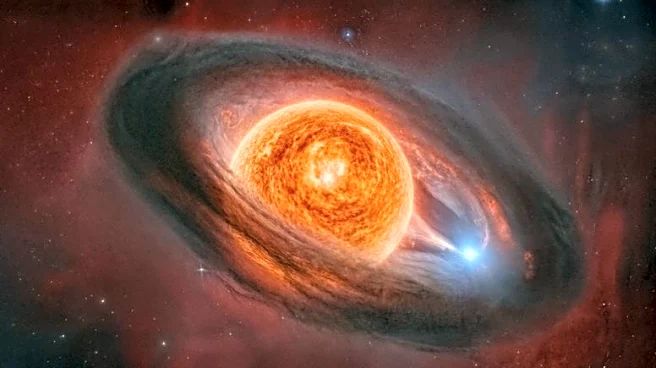
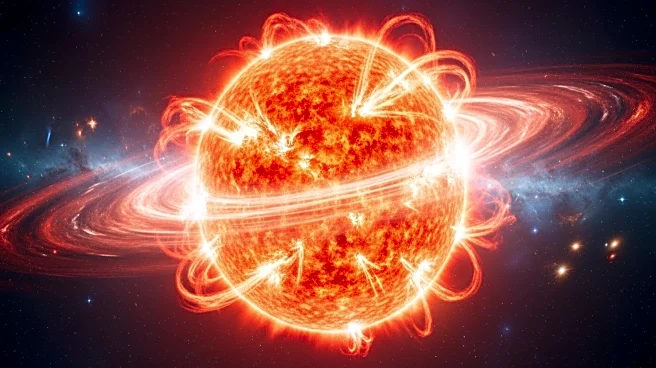
Astronomers have observed a significant transformation in one of the universe's largest stars, WOH G64, located in the Large Magellanic Cloud, a satellite galaxy of the Milky Way. This star, which is 1,540 times the size of the sun, has been changing
from a red supergiant to a rare yellow hypergiant. The change was first noticed in 2014 by a team led by Gonzalo Muñoz-Sanchez at the National Observatory of Athens. The star's color and surface temperature have been altering, suggesting it may be nearing the end of its life, potentially leading to a supernova explosion and the formation of a black hole. This transformation is significant as it provides evidence of a star evolving from red to yellow in a smooth manner, which is unusual for such massive stars.
Why It's Important?
The transformation of WOH G64 is crucial for understanding the life cycle of massive stars. These stars 'live fast and die young,' burning through their nuclear fuel quickly. The observation of WOH G64's transformation offers insights into the uncertain end stages of massive stars, which can either explode as supernovas or collapse into black holes. This discovery could help astronomers predict the fate of similar stars and improve models of stellar evolution. The potential supernova event could have implications for the study of cosmic phenomena and the distribution of elements in the universe, as supernovas play a key role in dispersing heavy elements across galaxies.
What's Next?
Astronomers will continue to monitor WOH G64 to gather more data on its transformation and eventual fate. The ongoing observation could provide further evidence of the processes leading to supernova explosions or black hole formation. This research may also prompt additional studies on other massive stars undergoing similar transformations, enhancing the understanding of stellar life cycles. The findings could influence future astronomical research and the development of new technologies for observing distant cosmic events.
Beyond the Headlines
The transformation of WOH G64 highlights the dynamic and often unpredictable nature of the universe. It underscores the importance of continuous observation and research in astronomy to uncover the mysteries of stellar evolution. The study of such massive stars can also contribute to broader scientific knowledge, including the origins of elements essential for life and the mechanisms driving cosmic change. This event may inspire further exploration into the ethical and philosophical implications of understanding the universe's vast and complex processes.