
What's Happening?
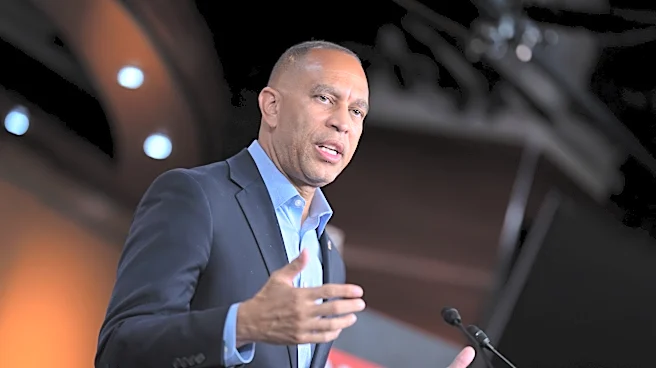
Democratic Rep. Ritchie Torres of New York has publicly condemned Palestinian journalist Rula Jebreal for referring to House Minority Leader Hakeem Jeffries as an 'AIPAC monkey' during a recent podcast.
Torres asserted that calling a Black man a 'monkey' is unequivocally racist. The Congressional Black Caucus echoed this sentiment, stating on X that there is no non-racist interpretation of such language when directed at a Black individual. Jebreal had criticized Jeffries for his support of Israel and alleged receipt of funds from AIPAC. While she initially claimed her comment referenced the 'three monkeys' idiom (see no evil, hear no evil, speak no evil) and denied racist intent, she later issued an unconditional apology on X, acknowledging that her expression was inappropriate and offensive and should not have been used.
Why It's Important?
This incident highlights the ongoing sensitivity and gravity surrounding racially charged language in public discourse, particularly when directed at political figures. The swift condemnation from Rep. Torres and the Congressional Black Caucus underscores the zero-tolerance stance against such remarks within political circles. It also brings to the forefront the intersection of political criticism, racial insensitivity, and the potential for language to dehumanize individuals. The controversy could further strain relationships between different political and advocacy groups, particularly those involved in discussions surrounding U.S. foreign policy and support for Israel. The incident serves as a reminder of the significant impact words can have, even when intent is later clarified or apologized for, and the immediate need for accountability in public commentary.
What's Next?
Following Jebreal's apology, the immediate public outcry may subside, but the incident could have lingering effects on her professional standing and credibility as a journalist. Political figures like Rep. Torres and the Congressional Black Caucus will likely continue to advocate for respectful and non-racist discourse, especially concerning minority leaders. The event may also prompt further discussions within media organizations and public platforms about vetting content and guest commentary to prevent the dissemination of offensive language. It remains to be seen if this incident will lead to broader policy discussions regarding hate speech or discriminatory language on digital platforms, or if it will primarily serve as a cautionary tale for public figures regarding their choice of words.
Beyond the Headlines
The controversy extends beyond a simple apology, touching upon deeper issues of racial tropes and their historical context. The term 'monkey' has a long and painful history of being used to dehumanize Black individuals, making its use particularly egregious regardless of the speaker's stated intent. This incident also reflects the broader challenges of navigating complex geopolitical discussions, such as the Israeli-Palestinian conflict, without resorting to prejudiced or inflammatory language. It underscores the responsibility of public commentators to be acutely aware of the historical and social implications of their words, especially when criticizing political leaders. The swift and unified condemnation from Black political leaders reinforces the ongoing fight against systemic racism and the importance of calling out such language whenever it appears.