
What's Happening?
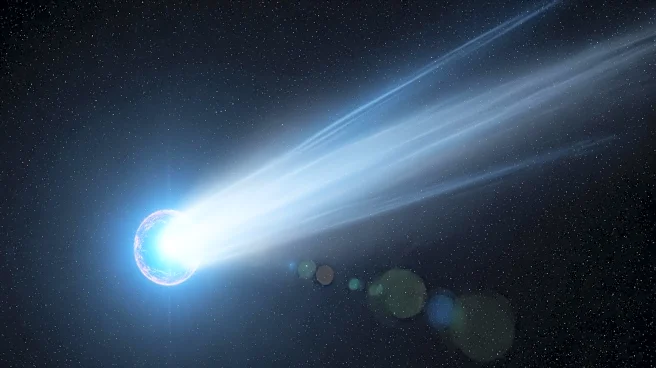
The interstellar comet 3I/ATLAS is set to make its closest approach to Earth on December 19, 2025. Discovered on July 1 by the NASA-funded ATLAS survey telescope in Río Hurtado, Chile, the comet has been
closely monitored by scientists. It is the third known interstellar object to pass through our solar system, traveling at a speed of 130,000 miles per hour. The comet will come within 167 million miles of Earth, posing no threat to the planet. This event provides a unique opportunity for astronomers to study the comet's size, composition, and trajectory, which confirm its interstellar origin. Observers can view the comet using ground-based telescopes, as it will be visible from Earth during its closest approach.
Why It's Important?
The passage of 3I/ATLAS is significant for the scientific community as it offers a rare chance to study an interstellar object. Such objects can provide valuable insights into the composition and behavior of celestial bodies from outside our solar system. Understanding these objects can enhance our knowledge of the universe and the processes that govern it. The comet's high speed and trajectory are of particular interest, as they differ from typical solar system comets. This event also highlights the capabilities of modern astronomical technology and international collaboration in tracking and studying distant celestial phenomena.
What's Next?
As 3I/ATLAS approaches, astronomers will continue to observe and gather data on the comet. This information will be analyzed to gain a deeper understanding of its characteristics and origins. The findings could contribute to future research on interstellar objects and their impact on our solar system. Additionally, the public interest in such celestial events may encourage further investment in space exploration and research initiatives. The scientific community will likely publish detailed reports and studies following the comet's passage, sharing new insights with the global audience.