



What's Happening?
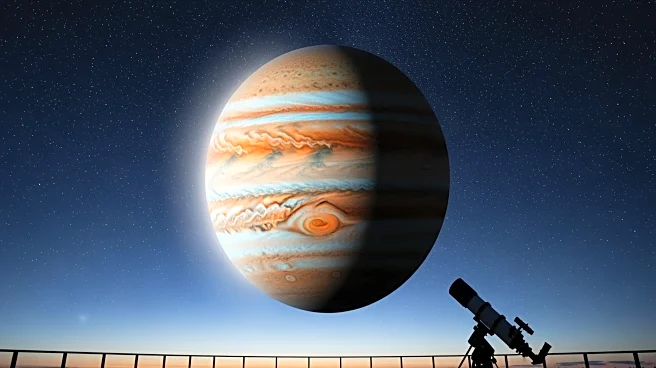
Jupiter is set to be at its most visible and brightest in 2026 as it reaches opposition on January 10. This astronomical event occurs when Jupiter aligns directly opposite the sun with Earth in the middle, making it an ideal time for stargazers to observe
the gas giant. Jupiter will be visible in the eastern sky at sunset, shining brightly among the stars of the constellation Gemini. The planet will reach its closest point to Earth, appearing larger and brighter through telescopes. The event will also allow viewers to see Jupiter's four largest moons, known as the Galilean moons, in a line formation. This celestial alignment provides a unique opportunity for both amateur and professional astronomers to observe and photograph Jupiter's atmospheric details and its moons.
Why It's Important?
The opposition of Jupiter is significant for astronomers and space enthusiasts as it provides a rare opportunity to observe the planet in great detail. This event allows for enhanced visibility of Jupiter's atmospheric features and its moons, contributing to scientific research and public interest in astronomy. The increased brightness and size of Jupiter during opposition make it an attractive target for astrophotography, encouraging educational and recreational activities related to space observation. Such events also help raise awareness about planetary science and the dynamics of our solar system, fostering a greater appreciation for celestial phenomena.
What's Next?
Following the opposition, Jupiter will continue to be a prominent feature in the night sky for several weeks, gradually moving away from its closest point to Earth. Astronomers and enthusiasts will likely continue to observe and document the planet's features, contributing to ongoing research and public engagement in astronomy. Educational institutions and observatories may organize events and viewing sessions to capitalize on the heightened interest in Jupiter. The data collected during this period could enhance our understanding of Jupiter's atmospheric dynamics and its interaction with its moons.