






What's Happening?
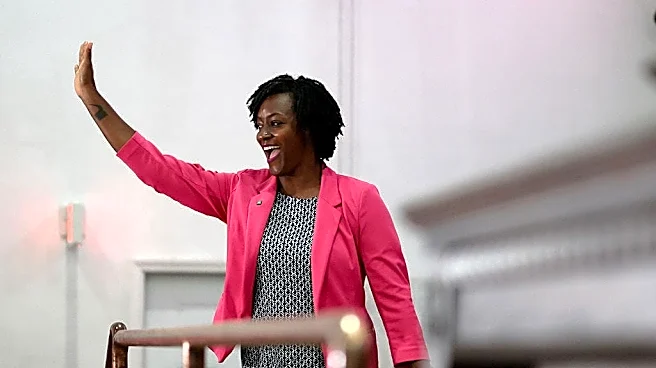
House Democratic Leader Fentrice Driskell has won the Democratic Primary for Senate District 16, defeating state Representative Michele Rayner. This victory effectively secures Driskell's transition from the House to the Senate, as there is no Republican
candidate in the race for this district. With all precincts reporting, Driskell garnered over 54% of votes in Pinellas County and nearly 63% in Hillsborough County, while Rayner received approximately 46% and 37% respectively. The district, which spans parts of Tampa and St. Petersburg, will now be represented by Driskell, succeeding term-limited state Senator Darryl Rouson. Both candidates campaigned on similar platforms, emphasizing affordability, public education, healthcare, and support for working families, and both have historically opposed the Republican agenda in Tallahassee. Driskell, first elected to the House in 2018, became the first Black woman to lead a party caucus in the chamber.
Why It's Important?
Fentrice Driskell's move from the Florida House to the Senate signifies a shift in Democratic leadership within the state legislature. As a prominent figure who previously led the House Democratic caucus and successfully raised significant funds for House races, her presence in the Senate could influence the Democratic party's strategy and legislative priorities. Her track record of bipartisan collaboration, such as working with then-Republican state Representative Cord Byrd on police reform, suggests a potential for cross-party engagement on certain issues, despite the Republican-controlled Legislature. However, her past efforts on issues like protecting abandoned historic cemeteries and stabilizing Florida's property insurance market have faced obstacles, indicating the challenges she may continue to encounter in the Senate. Her focus on worker protections, public school funding, teacher pay, Medicaid expansion, and local government authority reflects key policy areas that will likely be central to her legislative agenda and could impact various segments of Florida's population.
What's Next?
Following her primary victory, Fentrice Driskell will proceed to represent Senate District 16, as there is no Republican opposition in the general election. Her transition to the Senate will likely see her continue to advocate for the issues she championed during her campaign, including worker protections, increased public school funding, and Medicaid expansion. Given her experience in leading a party caucus and her fundraising capabilities, she is poised to play a significant role in the Democratic party's legislative efforts in the Senate. Her past attempts to legislate across party lines suggest she may seek opportunities for bipartisan cooperation, though the Republican majority in the Legislature will continue to present challenges for many of her proposals. The impact of her leadership will be observed as the next legislative session unfolds, particularly in how she navigates the political landscape to advance her policy goals and represent her constituents in Tampa and St. Petersburg.
Beyond the Headlines
Driskell's ascent to the Florida Senate carries broader implications for representation and political dynamics within the state. As the first Black woman to lead a party caucus in the House, her continued rise in the legislature underscores the evolving landscape of political leadership in Florida. Her background, including her education at Harvard and Georgetown Law and her career as a business litigator, positions her as a formidable voice in policy debates. The contrast in political approaches between Driskell and her primary opponent, Michele Rayner, highlights the diverse strategies within the Democratic party in Florida, ranging from Driskell's more collaborative approach to Rayner's outspoken advocacy. Driskell's emphasis on issues like artificial intelligence data center oversight, including energy and water use, points to emerging legislative concerns that will become increasingly relevant in a technologically advancing state. Her success also reflects the power of endorsements from a wide array of Democratic officials and organized labor, indicating a unified front behind her candidacy.