



What's Happening?
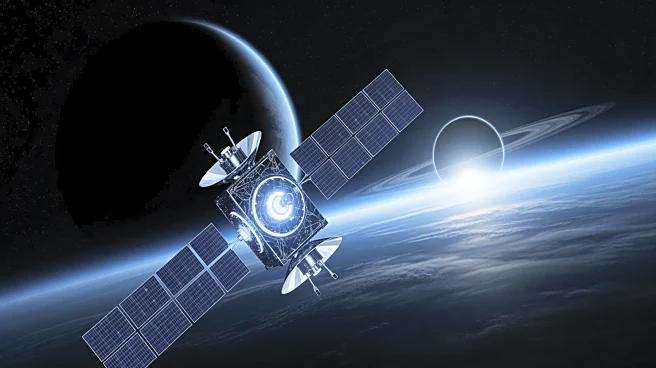
SpaceX is set to launch NASA's Pandora satellite on January 11, 2026, from Vandenberg Space Force Base in California. The mission aims to study at least 20 known exoplanets using a 17-inch-wide telescope. Pandora will observe these exoplanets as they
transit their host stars, a method that has been instrumental in discovering over 6,000 alien planets. The satellite will help astronomers understand the atmospheres of these exoplanets by analyzing the spectrum of starlight that passes through them. This mission is part of a broader effort to disentangle the complex signals from exoplanets' atmospheres and their stars, which is complicated by the non-uniform brightness of star surfaces.
Why It's Important?
The launch of Pandora is significant for the field of astronomy as it enhances the ability to study exoplanetary atmospheres, which is crucial for understanding the potential habitability of these distant worlds. By providing detailed data on atmospheric composition, Pandora could help identify planets with conditions suitable for life. This mission also represents a continued collaboration between NASA and SpaceX, showcasing the growing role of private companies in space exploration. The findings from Pandora could influence future missions and the search for extraterrestrial life, impacting scientific research and public interest in space exploration.
What's Next?
Following the launch, Pandora will embark on a yearlong mission to gather data on exoplanetary atmospheres. The results could lead to new insights into the formation and evolution of planetary systems. The mission's success may pave the way for more advanced telescopes and satellites dedicated to exoplanet research. Additionally, the data collected could inform the development of future space missions aimed at exploring these distant worlds more closely.