




What's Happening?
Recent observations of high-redshift quasars, which formed less than a billion years after the Big Bang, are providing crucial insights into the rapid formation of supermassive black holes (SMBHs) in the early universe. A paper published in Astronomy
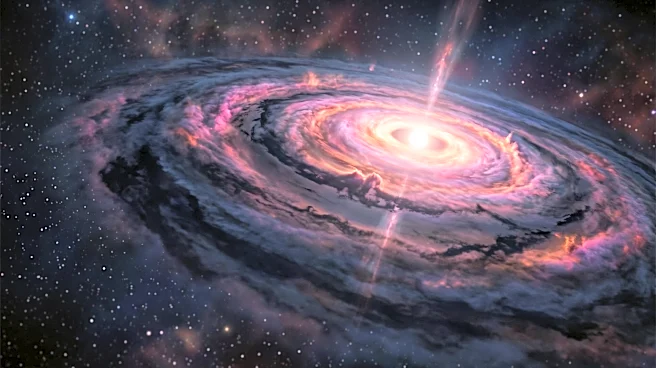
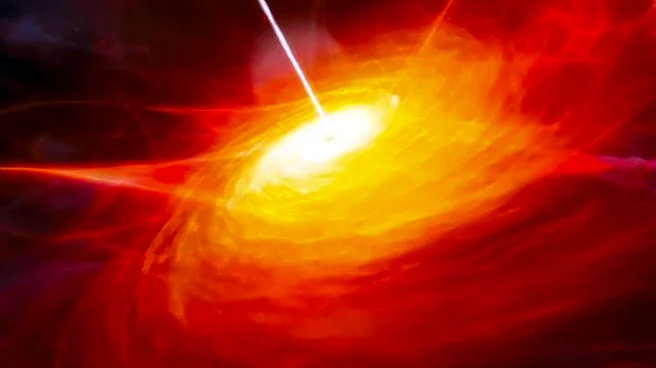
& Astrophysics details the discovery of two of the most distant quasars ever observed by the European Space Agency’s Euclid Space Telescope. These quasars, powered by SMBHs millions to billions of times the mass of the Sun, grow by accreting material that forms a dense, hot disk, outshining entire galaxies. The most distant quasar detected, EUCL J172902.75+641018.1, dates back to when the cosmos was only 662 million years old. Astrophysicists are puzzled by how these massive black holes grew so quickly in such a short cosmic timeframe. The study of these objects, which emit primarily in the ultraviolet but are observed in the infrared due to cosmic redshift, is key to understanding the co-evolution of SMBHs and their host galaxies.
Why It's Important?
Understanding the formation and growth of supermassive black holes in the early universe is fundamental to comprehending galactic evolution. Every large galaxy, including the Milky Way, hosts an SMBH at its center, and their rapid formation poses a significant challenge to current cosmological models. The existence of billion-solar-mass black holes when the universe was less than a billion years old suggests mechanisms for growth that are not fully understood. Quasars act as beacons, allowing scientists to study these early SMBHs and the conditions of the nascent universe. The data from these distant quasars help constrain theories about how matter accumulated so quickly to form such massive objects. This research is vital for refining models of galaxy formation, the distribution of dark matter, and the overall structure of the cosmos. It also highlights the power of advanced telescopes like Euclid in pushing the boundaries of observational astronomy.
What's Next?
Future research will focus on analyzing more data from telescopes like Euclid, Keck, Magellan, and the Large Binocular Telescope to identify additional high-redshift quasars. Scientists will continue to develop and refine computational models that incorporate magnetism, hydrodynamics, and turbulence in curved spacetime to explain the rapid growth of early SMBHs and the formation of their powerful jets. The challenge lies in solving complex equations that are at the limit of current computational techniques. Further observations will aim to gather more precise data on the properties of these quasars, such as their luminosity and spectral characteristics, to better understand the accretion processes and the physical conditions in their host galaxies. The ongoing quest to understand these early cosmic giants will continue to shape our understanding of the universe's origins and evolution.
Beyond the Headlines
The study of distant quasars delves into some of the most profound questions about the universe's origins and evolution. The rapid formation of supermassive black holes in the early cosmos challenges our understanding of how structures emerge from the primordial soup of the Big Bang. This research touches upon the interplay between fundamental physics, such as gravity and electromagnetism, and the large-scale cosmic structures we observe today. The fact that these ancient objects can still be detected and studied, albeit in redshifted light, is a testament to the ingenuity of modern astronomy. It also underscores the idea that the universe's past holds the keys to its present and future, with the evolution of black holes being intimately linked to the evolution of galaxies. The ethical and philosophical implications of understanding our cosmic origins are vast, as it informs our place in the universe and the fundamental laws that govern it.