






What's Happening?
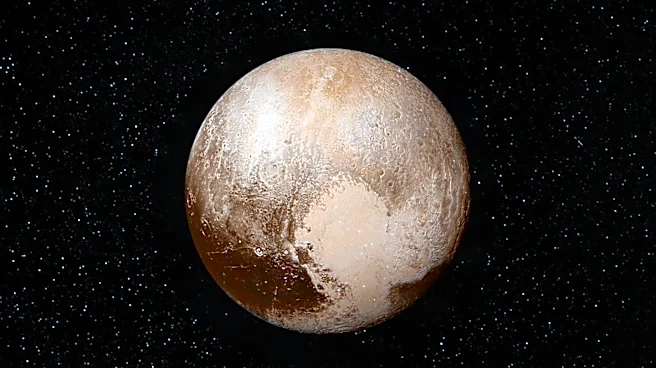
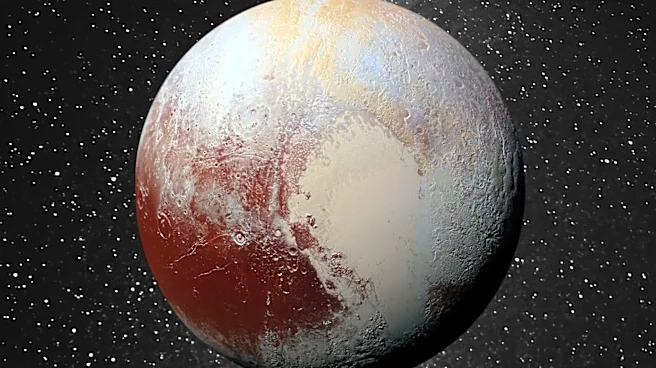
The James Webb Space Telescope (JWST) has detected an unexplained infrared signature on both Pluto and Saturn's moon Titan, suggesting similar chemical processes may be occurring on these two distinct celestial bodies. The discovery, led by Bruno Bézard
from the Paris Observatory, indicates the presence of an unknown compound or a family of related compounds. This signature appears at the same infrared wavelength on both worlds, absorbing light identically, which points to a shared chemical process despite the vast differences in their environments. Titan, with its dense atmosphere and methane seas, and Pluto, with its icy surface and thin atmosphere, both exhibit this mysterious feature, which has yet to be identified.
Why It's Important?
This discovery is significant as it suggests that similar prebiotic chemistry might be occurring on both Titan and Pluto, despite their different environments. The presence of this unknown compound could provide insights into the chemical processes that occur in nitrogen and methane-rich atmospheres, potentially offering clues about the early chemical conditions that could lead to life. Understanding these processes is crucial for astrobiology and the study of life's potential beyond Earth. The findings also highlight the capabilities of the JWST in detecting and analyzing chemical compositions on distant celestial bodies, advancing our knowledge of the solar system.
What's Next?
Further analysis of JWST data is expected to provide more detailed maps of Titan's surface, potentially linking the mysterious infrared signature to specific geological features. Additionally, NASA's upcoming Dragonfly mission to Titan, set to launch in 2028, may offer more direct insights by analyzing organic molecules on the moon's surface. These efforts aim to narrow down the possible compounds responsible for the signature, enhancing our understanding of extraterrestrial chemistry.