




What's Happening?
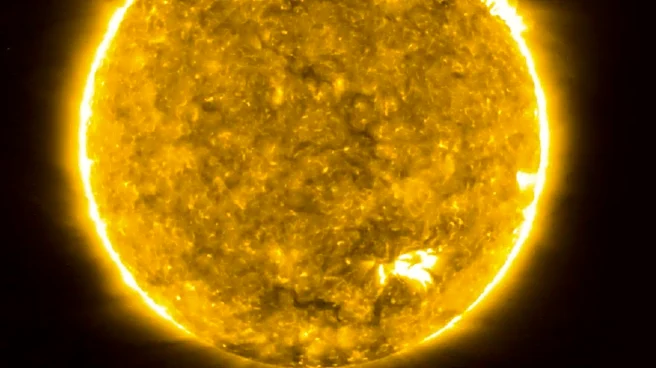
Astronomers have potentially solved the mystery of the sun's missing silver, a question that has puzzled scientists for years. The sun, primarily composed of hydrogen and helium, contains trace amounts of heavier elements like silver. However, previous
measurements indicated less silver than expected, based on comparisons with ancient meteorites known as CI chondrites. These meteorites, formed from the same primordial matter as the sun, should have similar silver levels. Recent research led by Sema Caliskan, a postdoctoral researcher at the University of Liège, suggests that the missing silver may have been obscured by complex atomic interactions. Using advanced simulations on the Tetralith supercomputer, the team accounted for non-equilibrium effects, which previous models had overlooked. Their findings indicate that the sun contains 55% more silver than previously measured, aligning more closely with CI chondrite levels.
Why It's Important?
This discovery is significant as it enhances our understanding of stellar composition and the distribution of elements in the universe. Silver, formed in supernova explosions, provides insights into the life cycles of stars and the chemical evolution of galaxies. By resolving the discrepancy in silver levels, astronomers can refine models of stellar formation and evolution, leading to more accurate predictions about the universe's history. This research also demonstrates the importance of advanced computational methods in astrophysics, highlighting how complex simulations can reveal hidden aspects of cosmic phenomena. The findings could influence future studies on other stars, potentially uncovering similar hidden elements and furthering our knowledge of the cosmos.
What's Next?
The research team plans to apply their simulation techniques to other types of stars, potentially uncovering more hidden elements and refining our understanding of stellar compositions. This approach could lead to new discoveries about the formation and evolution of stars across the galaxy. Additionally, the findings may prompt further investigations into the role of non-equilibrium effects in other astrophysical phenomena, potentially leading to breakthroughs in our understanding of the universe's chemical makeup. As computational power continues to grow, these methods could become a standard tool in astrophysical research, offering deeper insights into the mysteries of the cosmos.