

What's Happening?
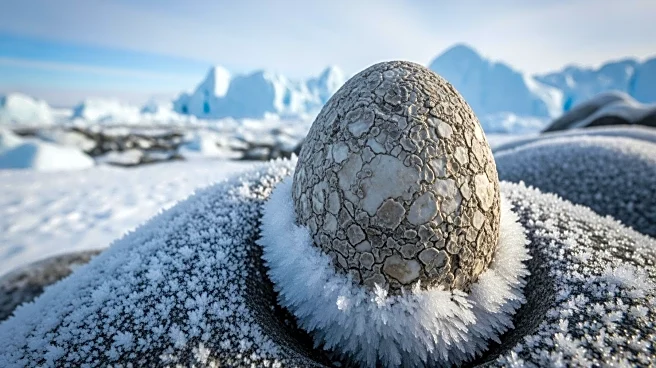
A 68-million-year-old fossil egg, nicknamed 'The Thing,' has been unearthed in Antarctica, revealing new insights into the reproductive strategies of ancient marine reptiles. The egg, measuring 11 inches long and 8 inches wide, is the largest soft-shelled
egg ever found and the second largest egg from any animal. Initially mistaken for a deflated bag, the egg's thin, flexible shell suggests it was laid by a large marine reptile, possibly a mosasaur, rather than being birthed live as previously assumed. This discovery, led by paleontologist Lucas Legendre from the University of Texas at Austin, challenges the long-held belief that large marine reptiles gave birth to live young. The egg's proximity to bones of Kaikaifilu hervei, a large mosasaur species, supports the hypothesis that these reptiles laid eggs in water, with young hatching almost immediately.
Why It's Important?
This discovery is significant as it alters the understanding of reproductive strategies among ancient marine reptiles, suggesting a mixed approach of egg-laying and live birth. The findings could reshape theories about the evolution of reproductive methods in reptiles, highlighting the diversity of life strategies in prehistoric times. The preservation of such a delicate fossil in Antarctica's sedimentary environment also provides a rare glimpse into the region's ancient ecosystem, which functioned as a nursery for marine life. This contributes to the broader understanding of how life adapted to polar environments during the Late Cretaceous period.
What's Next?
Further research is expected to focus on confirming the identity of the egg-laying species and exploring the implications of this reproductive strategy on the survival and evolution of marine reptiles. Scientists may also investigate other fossil sites in Antarctica to uncover additional evidence of reproductive behaviors. This could lead to a deeper understanding of how ancient ecosystems functioned and how species adapted to changing climates and environments over millions of years.
Beyond the Headlines
The discovery of 'The Thing' adds to the growing body of evidence that soft-shelled eggs were more common among ancient reptiles than previously thought. This challenges the notion that hard-shelled eggs were the ancestral norm, suggesting that soft-shelled eggs may have been the original form, with hard shells evolving independently in different lineages. The preservation of such eggs is rare, offering unique insights into the reproductive biology and environmental adaptations of prehistoric species.