






What's Happening?
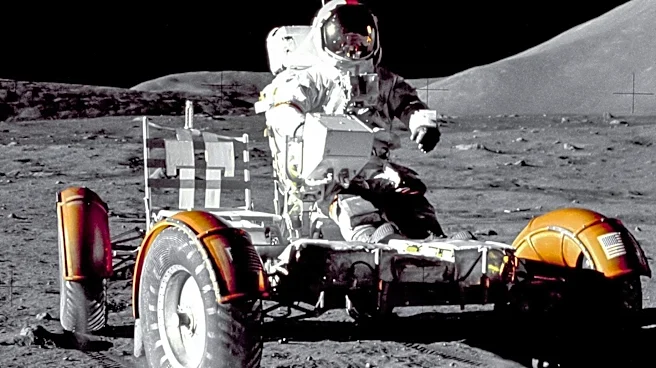
NASA has concluded a challenge to develop next-generation lunar rover wheels, crucial for advancing surface mobility as the agency prepares to establish a Moon Base. The 'Rock and Roll with NASA Challenge' invited public innovators to design and build
lightweight, durable, and scalable wheels capable of supporting longer-duration lunar surface operations. Five teams, selected from 128 submissions across 49 countries, tested their prototypes on July 31 at NASA's Johnson Space Center in Houston. The designs needed to absorb impacts, maintain traction at higher speeds, and withstand the harsh lunar environment. The wheels were fitted to MicroChariot, a 45-kilogram test rover, and evaluated across various terrains at Johnson's Rock Yard. The winning concept, 'Scotch Pad Tyres,' developed by Daniel and Isaac Bloomfield, features a Nomex-based tire structure with an aluminum hub, designed to deform around terrain while maintaining shape with internal support and improved traction from an epoxy and corundum grit outer surface.
Why It's Important?
Advancements in lunar surface mobility are critical for expanding the scope of exploration, scientific achievement, and infrastructure development on the Moon. As robotics engineer Ed Herrera noted, every additional kilometer a rover can reliably travel significantly enhances mission capabilities. The challenge's crowdsourcing approach allows NASA to explore innovative designs beyond traditional aerospace industry methods, providing a wider array of wheel technologies suitable for diverse vehicles, terrains, and missions on both the Moon and Mars. This initiative directly supports the Artemis program's long-term goals of establishing a sustainable human presence on the Moon, which necessitates robust and reliable transportation systems for astronauts and robotic systems. The insights gained from testing these prototypes will inform future lunar vehicle development, ensuring that upcoming missions can traverse challenging lunar landscapes more effectively and safely.
What's Next?
The next phase of evaluation for these lunar wheel designs will involve testing their response to lunar-like dust, vacuum, and extreme temperatures within Johnson Space Center's thermal vacuum chambers. Engineers also plan to assess the designs over longer distances and at different sizes and loads to understand their full capabilities and limitations. This continued testing will help refine the prototypes for potential integration into future lunar terrain vehicles, which are expected to be delivered to the lunar surface through the Commercial Lunar Payload Services initiative. The insights from this challenge will also contribute to the broader understanding of lunar mobility, influencing the development of various vehicles that will require different combinations of speed, load capacity, durability, and terrain performance for future lunar exploration missions.
Beyond the Headlines
The 'Rock and Roll with NASA Challenge' highlights a growing trend in space exploration: leveraging public innovation and crowdsourcing to solve complex engineering problems. This approach not only brings fresh perspectives and diverse ideas but also fosters public engagement and interest in space science and technology. By involving individuals and teams from around the world, NASA is democratizing access to space development, potentially accelerating technological breakthroughs. The challenge also underscores the ethical considerations of long-term lunar presence, as durable and efficient mobility systems are essential for minimizing environmental impact and ensuring the safety of future human and robotic missions. The development of these wheels is not just about transportation; it's about enabling sustainable exploration and resource utilization on extraterrestrial bodies, paving the way for humanity's expansion into the solar system.