
What's Happening?
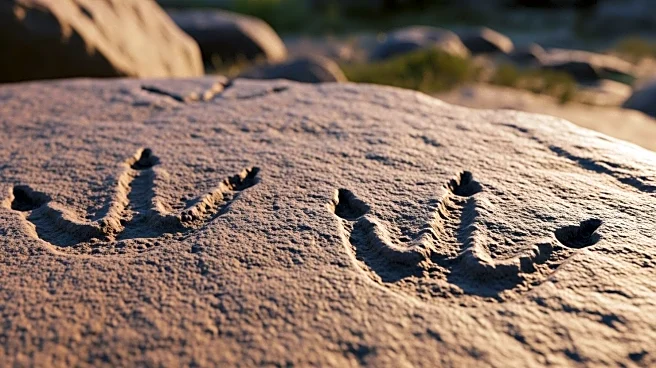
Italian officials have announced the discovery of thousands of dinosaur tracks in Stelvio National Park, located in the central Alps of northern Italy. These tracks, found on nearly vertical dolomite walls, date back approximately 210 million years to
the Late Triassic period. The discovery was made by nature photographer Elio Della Ferrara, who stumbled upon the tracks while photographing wildlife. The tracks are believed to belong to herbivorous prosauropod dinosaurs, ancestors of the giant sauropods. This is the first time dinosaur tracks have been found in the Lombardy region, north of the Insubric Line, a significant tectonic boundary. The tracks are preserved in excellent condition, showing traces of toes and claws, and are located in an area that will host events for the upcoming Milan-Cortina 2026 Winter Olympics.
Why It's Important?
The discovery of these tracks provides valuable information about the distribution and behavior of prosauropod dinosaurs, which are not well understood. It offers a unique opportunity to study the evolutionary history of these creatures and their environment during the Triassic period. The tracks' location in a high-altitude, mountainous region adds to the intrigue, as it suggests these dinosaurs inhabited diverse landscapes. This finding could lead to new insights into the geological history of the Alps and the tectonic processes that shaped the region. The discovery also enhances the cultural and scientific significance of the area, potentially attracting interest from both the scientific community and the public.
What's Next?
Researchers plan to use drones and remote sensing technologies to study the tracks further, as the area is not accessible by trails. This non-invasive approach will allow scientists to gather detailed data without disturbing the site. Italian officials hope that continued research will answer questions about the prosauropods' evolutionary relationships and their role in the ecosystem. The discovery may also lead to increased interest in paleontological research in the region, potentially uncovering more fossils and tracks.