








What's Happening?
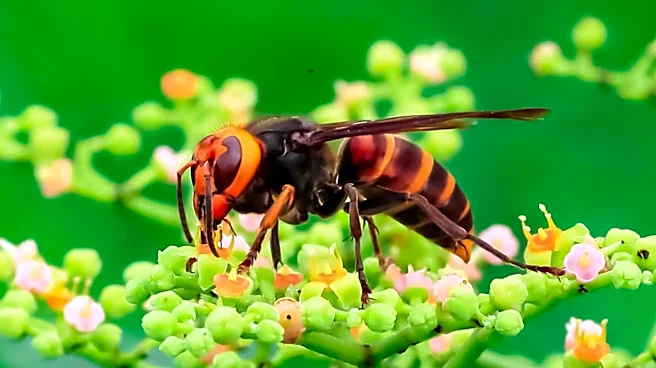
A nest of the Asian yellow-legged hornet, Vespa velutina, was discovered in Wielka Wieś near Krakow, Poland, and subsequently eliminated. The nest, which contained approximately a thousand workers, several dozen females and males, as well as eggs and larvae,
was handed over to the Wrocław University of Environmental and Life Sciences for research. Professor Paweł Migdał and his team conducted a biological assessment, confirming ongoing development within the nest. Researchers noted that young females had already departed the nest to overwinter and establish new nests in the upcoming season. This invasive species, known for preying on honey bees and other pollinators, was first recorded in Europe in France in 2004 and has since spread to countries including Germany, Slovakia, and the Czech Republic. Its presence was first detected in Poland in October, initially in Wielka Wieś and later at an apiary of the AGH University of Krakow.
Why It's Important?
The discovery and study of the Asian yellow-legged hornet in Poland highlight a significant ecological threat. As an invasive species, Vespa velutina poses a severe danger to native pollinator populations, particularly honey bees, which are crucial for agriculture and ecosystem health. The hornet's predatory behavior can decimate bee colonies, leading to reduced crop yields and broader ecological imbalances. The fact that young females had already left the nest to establish new ones indicates a potential for rapid spread, making containment and eradication efforts more challenging. Understanding the hornet's entry point into Poland is critical for assessing the scale of its spread and implementing effective control measures. The economic impact on beekeeping industries and agriculture could be substantial if the hornet establishes a widespread presence, affecting food security and biodiversity.
What's Next?
Researchers are focused on determining the origin of the hornet's entry into Poland to understand its dispersal patterns and identify potential additional nests. This information is crucial for developing targeted strategies to prevent further spread. Authorities and environmental agencies will likely increase monitoring efforts to detect new nests, especially in areas between Poland and previously affected countries like the Czech Republic and Slovakia. Public awareness campaigns may be necessary to educate citizens on identifying and reporting sightings of the hornet, as early detection is vital for effective management. Control measures, such as nest destruction and trapping, will be critical to mitigate the hornet's impact on local ecosystems and agricultural sectors. The long-term goal is to prevent the establishment of a permanent, widespread population of this invasive species in Poland and potentially other parts of Europe.
Beyond the Headlines
The ongoing spread of the Asian yellow-legged hornet underscores the broader challenge of invasive species in a globalized world. Increased international trade and travel facilitate the accidental introduction of non-native species, which can have devastating consequences for local biodiversity and economies. This incident highlights the need for robust biosecurity measures at borders and continuous ecological monitoring. The hornet's impact on pollinators also brings into focus the fragility of agricultural systems and the interconnectedness of ecosystems. Beyond immediate control efforts, this situation may prompt a re-evaluation of international cooperation strategies for managing invasive species, emphasizing early warning systems and coordinated responses across national borders to protect ecological and economic interests.