




What's Happening?
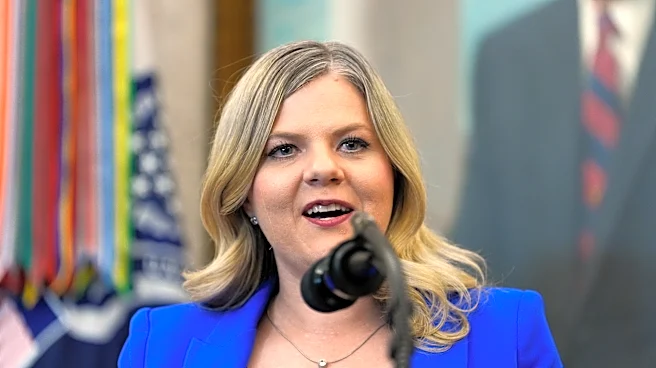
Senator Elizabeth Warren, a Democrat from Massachusetts, has demanded explanations from Trump administration officials regarding the removal of language banning political interference from the Census Bureau's parent agency's scientific integrity policy.
This change, first reported by NPR, has raised concerns about the reliability of U.S. demographic and economic statistics. The updated policy no longer includes 'protection from inappropriate influence' as a hallmark of scientific integrity. This revision, dated August 19, occurred a day after the bureau released a document by a team with ties to the America First Policy Institute, which data and election experts have criticized as questionable. Other recent controversial moves by the Trump administration include banning a data privacy protection technique, which delayed the release of some survey results, and proposing to exclude certain non-U.S. citizen residents from the census count that determines congressional districts and Electoral College votes. The administration also suggested discontinuing the use of the census to produce data on race and ethnicity.
Why It's Important?
The removal of the ban on political interference from the Census Bureau's scientific integrity policy has significant implications for the accuracy and impartiality of official U.S. statistics. These statistics are crucial for various sectors, including economic data, the redistricting process that determines congressional representation, the Federal Reserve's monetary policy decisions, and the enforcement of civil rights laws. Any perceived or actual political interference could undermine public trust in these vital data sources, leading to misinformed policy decisions and potentially skewed representation. The proposed changes to the census, such as excluding non-U.S. citizens from the count and ceasing to collect race and ethnicity data, could fundamentally alter the demographic understanding of the country, impacting resource allocation, social programs, and the political landscape. These actions raise concerns about the integrity of the nation's statistical system and its ability to provide an unbiased reflection of the U.S. population.
What's Next?
Senator Warren has sent letters to Commerce Secretary Howard Lutnick and other officials, requesting a clear explanation for the removal of the language and how the decision was reached. She is also probing whether the Office of Management and Budget, a White House agency, was involved in the Commerce Department's decision. Additionally, Senator Warren is asking the Federal Reserve how it ensures the accuracy of the data it relies on from the Census Bureau. The Fed has stated its intention to respond to Warren's letter by October 7. The outcome of these inquiries could lead to further congressional oversight, potential legal challenges, or a reevaluation of the scientific integrity policies within federal agencies. The ongoing debate highlights the critical importance of maintaining the independence and objectivity of federal statistical agencies to ensure the reliability of data used for governance and public understanding.
Beyond the Headlines
The controversy surrounding the Census Bureau's scientific integrity policy points to a broader struggle over the role of objective data and scientific expertise in government. The administration's actions suggest a potential shift towards prioritizing political narratives over empirical evidence, which could have long-term consequences for evidence-based policymaking. The erosion of trust in official statistics could lead to increased polarization and make it more challenging to address national issues effectively, as different factions may operate with conflicting understandings of reality. This situation also raises questions about the checks and balances designed to protect federal agencies from undue political influence and the mechanisms available to safeguard scientific integrity. The implications extend beyond mere data collection, touching upon the foundational principles of democratic governance that rely on accurate and unbiased information to inform public discourse and decision-making.