








What's Happening?
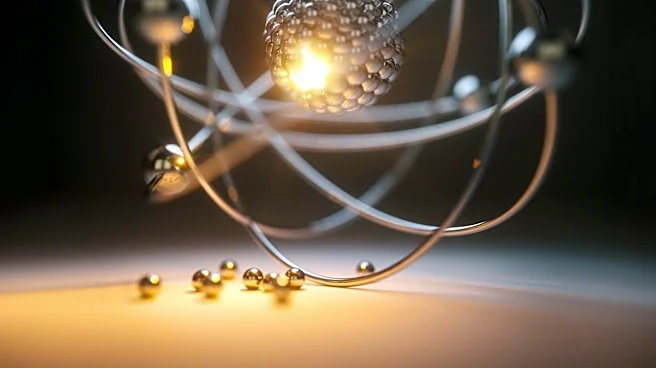
Giovanni Barontini, a physicist at the University of Birmingham, has conducted an experiment to explore the emergence of time within an isolated quantum system. By creating a 'mini-universe' using a Bose-Einstein condensate, Barontini demonstrated that
time can arise from within a system without external reference. The experiment involved splitting the system into two parts and observing the flow of entropy between them, which acted as an internal clock. This study provides experimental support for theories in quantum cosmology and thermodynamics regarding the nature of time.
Why It's Important?
This experiment is significant as it provides empirical evidence for theoretical concepts about time in quantum systems, which have been debated for decades. Understanding how time emerges in isolated systems could have profound implications for quantum mechanics and cosmology. It challenges the traditional notion of time as a fundamental aspect of reality, suggesting it may instead be a relational property arising from interactions within a system. This could lead to new insights into the nature of the universe and the development of quantum technologies.
What's Next?
Barontini's work opens the door for further experiments using cold-atom systems to simulate other complex phenomena, such as black holes or the early universe. These experiments could help answer fundamental questions in physics and advance our understanding of the universe. The research also suggests potential applications in developing new quantum technologies that leverage the unique properties of time emergence in isolated systems.