





What's Happening?
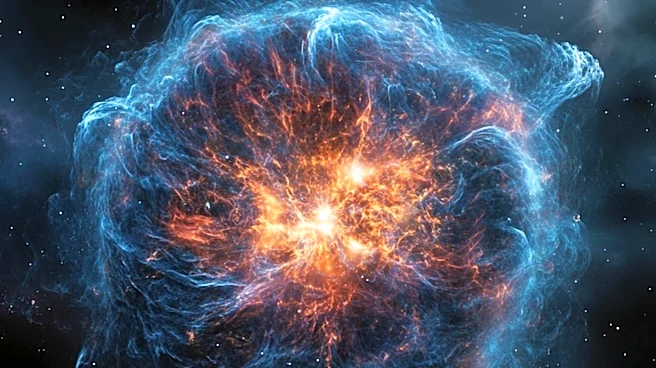
Astronomers have detected the first signs of the Diffuse Supernova Neutrino Background (DSNB), a flux of neutrinos believed to be produced by supernova explosions over billions of years. This discovery was made using the Super-Kamiokande neutrino detector
in Japan. Neutrinos, often called 'ghost particles' due to their elusive nature, are produced in massive quantities during supernova events. The detection of DSNB provides new insights into the life cycles of stars and the formation of neutron stars and black holes.
Why It's Important?
The detection of DSNB is a significant milestone in astrophysics, offering a new way to study the history of supernovae and the evolution of the universe. Understanding neutrinos can help scientists learn more about the processes that govern star death and the creation of heavy elements. This research could also enhance our knowledge of fundamental physics and the behavior of particles under extreme conditions, potentially leading to breakthroughs in both theoretical and applied sciences.
What's Next?
Researchers plan to continue observations with Super-Kamiokande and its successor, Hyper-Kamiokande, to improve sensitivity and confirm the DSNB signal. These efforts will involve analyzing more data and refining detection techniques. The ongoing research aims to provide a clearer picture of the universe's history and the role of neutrinos in cosmic events, potentially leading to new discoveries in particle physics and cosmology.