
What's Happening?
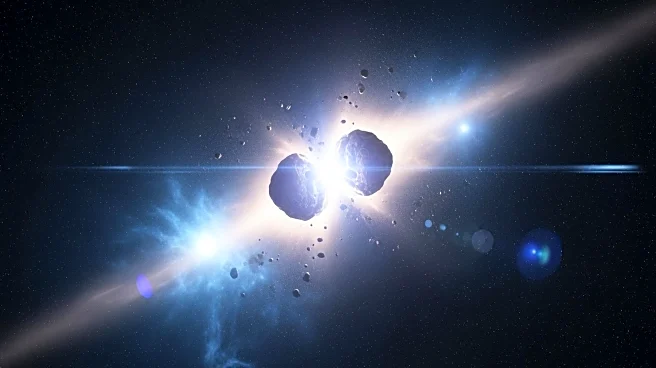
Astronomers using the NASA/ESA Hubble Space Telescope have observed catastrophic collisions in the Fomalhaut planetary system for the first time. The system, located 25 light-years from Earth, is experiencing
a dynamic upheaval similar to the early years of our solar system. The collisions were detected as points of light, identified as 'circumstellar source 1' (cs1) and 'circumstellar source 2' (cs2), which are massive debris clouds resulting from the impact of large objects. These findings challenge previous theories that such collisions occur once every 100,000 years, as two have been observed within 20 years. The research, led by Paul Kalas from the University of California, Berkeley, provides a unique opportunity to study the evolution of planetary systems.
Why It's Important?
The observation of these collisions is significant as it offers a rare glimpse into the processes that shape planetary systems. Understanding these events can provide insights into the formation and composition of planets, including those in our solar system. The findings suggest that such collisions may be more common than previously thought, which could have implications for the study of exoplanets and the search for life beyond Earth. The ability to observe these events in real-time allows scientists to gather data on the size and number of colliding bodies, enhancing our understanding of planetary system dynamics.
What's Next?
The research team plans to continue monitoring cs2 over the next three years using the Hubble Space Telescope. They aim to observe changes in its shape, brightness, and orbit, which could provide further insights into the behavior of debris clouds. Additionally, the James Webb Space Telescope will be used to study cs2 in the infrared spectrum, offering a more comprehensive analysis of the dust grains and their composition. These observations will help refine models of planetary system evolution and inform future missions aimed at detecting exoplanets.