





What's Happening?
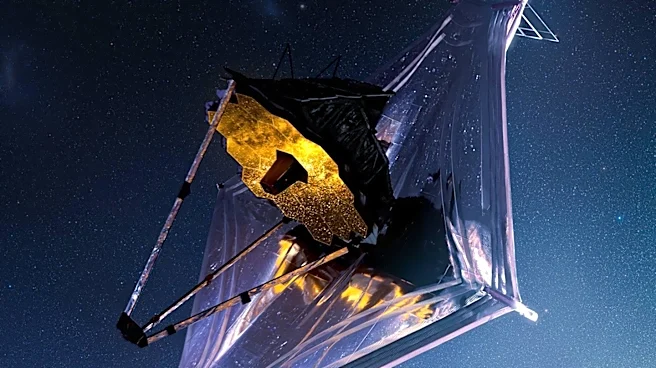
An international team of astronomers, utilizing NASA’s James Webb Space Telescope (JWST), has identified an exceptionally bright red object in the early universe, just 660 million years after the Big Bang. This object, named MoM-BH-1, appears to be an entirely
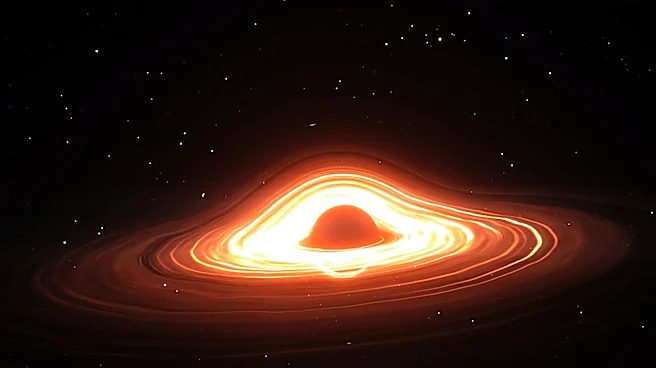
new class of astrophysical entity, described as a 'black hole star.' It resembles an enormous star, roughly the size of our solar system, but emits about 100 billion times more energy than any known star could physically produce. This extraordinary energy output is more consistent with a black hole. Researchers, including Dr. Rohan Naidu of the University of Hawaiʻi’s Institute for Astronomy, suggest that MoM-BH-1 consists of a central black hole with a mass approximately 100,000 times that of the sun, surrounded by a very extended gaseous envelope that mimics a star. The object's light is extremely bright across much of the spectrum but disappears completely below certain wavelengths, and it shows almost no evidence of metals or elements other than hydrogen and helium. This unique signature led the team to conclude that it is a black hole surrounded by a star-like gaseous envelope, a configuration never previously observed.
Why It's Important?
The discovery of MoM-BH-1, a 'black hole star,' is significant because it challenges existing astrophysical models and offers a potential explanation for other enigmatic observations made by the JWST. The object's immense brightness and unique composition, particularly its lack of heavy elements, provide crucial insights into the conditions and processes that existed in the very early universe. This finding could help astronomers understand how supermassive black holes formed so rapidly after the Big Bang, a long-standing puzzle in cosmology. Furthermore, researchers believe that black hole stars like MoM-BH-1 could explain many of the mysterious 'little red dots' observed by Webb, which are abundant in the early universe but whose nature has been largely unknown. This new class of object could represent a missing link in the evolutionary pathways of galaxies and black holes, fundamentally altering our understanding of cosmic dawn and the formation of the first massive structures.
What's Next?
The research team will continue to analyze MoM-BH-1 and other similar objects to refine their understanding of 'black hole stars.' Further observations with the James Webb Space Telescope and other advanced instruments will be crucial to confirm the proposed structure and composition of these entities. Scientists will likely focus on searching for more 'black hole stars' to determine their prevalence in the early universe and their role in cosmic evolution. The implications for the 'little red dots' will also drive future studies, as researchers attempt to correlate these mysterious objects with the 'black hole star' model. This discovery will undoubtedly lead to the development of new theoretical models to explain the formation and evolution of these unique objects, potentially revising our understanding of how black holes and galaxies grew in the universe's infancy. The ongoing analysis will aim to determine if these objects are a transient phase or a stable configuration in cosmic history.
Beyond the Headlines
The existence of 'black hole stars' pushes the boundaries of our imagination regarding the diversity of celestial objects. It highlights the universe's capacity to produce phenomena that defy conventional classifications and expectations. This discovery underscores the importance of continuous observation and the development of new technologies, like the JWST, in revealing previously unimagined cosmic realities. It also prompts deeper philosophical questions about the nature of matter and energy in extreme environments, and how fundamental forces can manifest in unexpected ways. The 'black hole star' serves as a powerful reminder that our understanding of the cosmos is constantly evolving, with each new discovery opening up more questions and expanding the frontiers of scientific inquiry. It encourages a sense of wonder and humility in the face of the universe's vast and mysterious complexity.