




What's Happening?
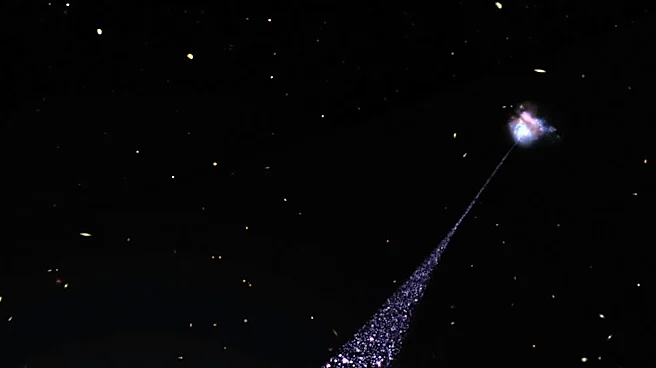
Astronomers have detected the most distant fast radio burst (FRB) ever recorded, designated FRB 20240304B. This burst traveled over 10 billion years to reach Earth, originating from a time when the Universe was approximately 3 billion years old. The event
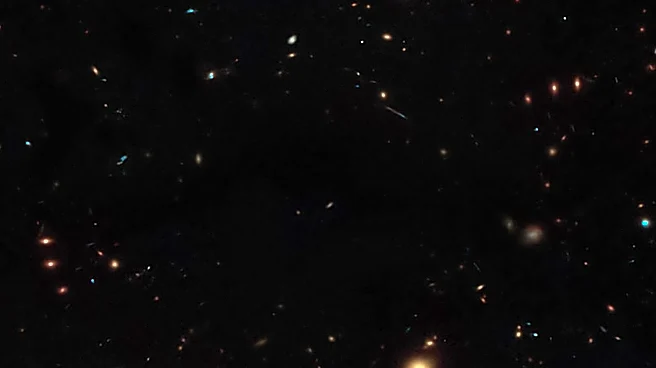
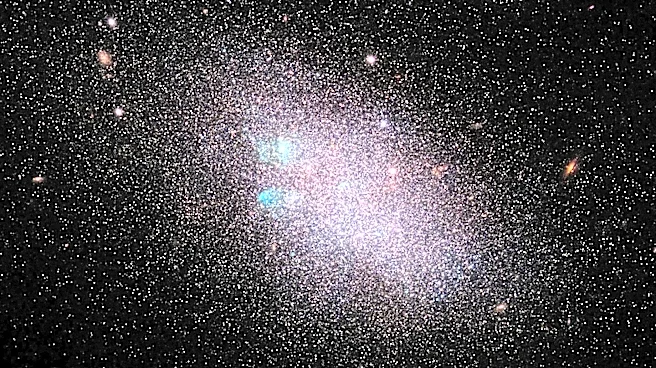
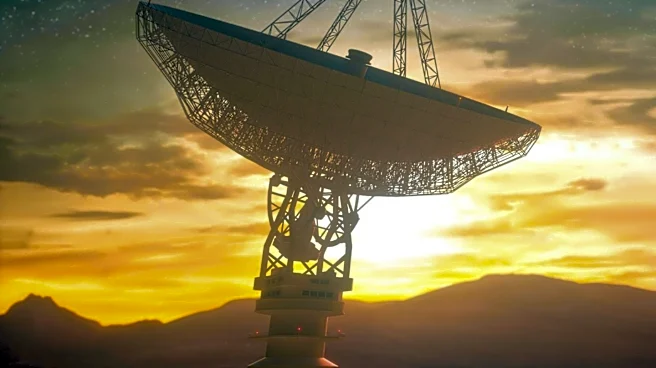
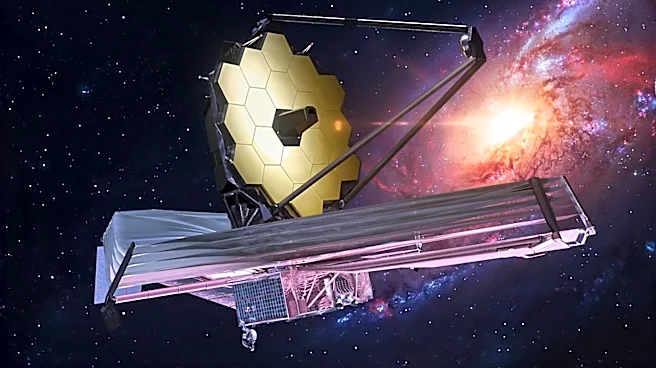
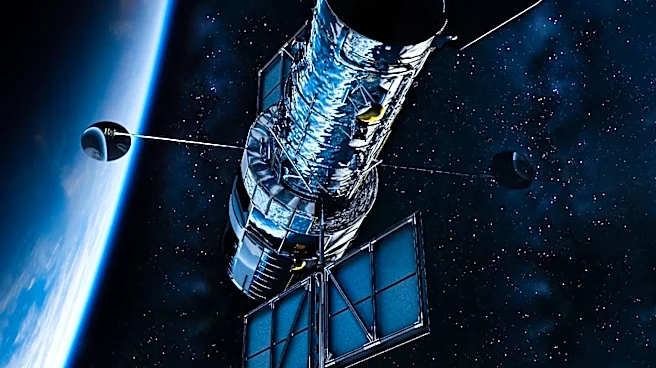
was initially detected on March 4, 2024, by the MeerTRAP project using South Africa’s MeerKAT radio telescope. To pinpoint its source, researchers utilized the Near-Infrared Camera (NIRCam) instrument on the NASA/ESA/CSA James Webb Space Telescope. The host galaxy, which was previously invisible to ground-based telescopes, was identified as a small, metal-poor, and actively star-forming galaxy. This discovery more than doubles the previous distance record for an FRB. The findings suggest that this FRB was likely produced by young magnetars, highly magnetized neutron stars formed in supernova explosions, rather than the merger of two neutron stars. Dr. Manisha Caleb, an astronomer at the University of Sydney, noted that the exact generation mechanism of FRBs remains uncertain, despite various theories.
Why It's Important?
This discovery significantly advances our understanding of fast radio bursts, which are among the most mysterious phenomena in astronomy. By tracing FRB 20240304B to a small, star-forming galaxy in the early Universe, scientists gain crucial insights into the conditions and environments that produce these powerful, millisecond-long energy releases. The identification of the host galaxy as metal-poor and actively forming stars supports the theory that at least some FRBs originate from young magnetars. This finding helps to narrow down the possible origins of FRBs, moving away from other theories such as the merger of neutron stars or even advanced extraterrestrial technology. The ability of the James Webb Space Telescope to pinpoint such a distant and faint host galaxy highlights its unparalleled capabilities, pushing the boundaries of astronomical observation and enabling scientists to study the Universe in its infancy. This research contributes to a broader understanding of cosmic evolution and the extreme physics governing the early Universe.
What's Next?
The next step for astronomers is to continue pushing the frontiers of FRB detection, aiming to observe bursts from even earlier generations of stars. Researchers will likely focus on identifying more distant FRBs and their host galaxies to further refine theories about their origins. The continued use of advanced telescopes like the James Webb Space Telescope will be crucial in this endeavor, as it can detect faint objects that are beyond the reach of ground-based instruments. Future studies will aim to gather more conclusive proof regarding the specific objects that generate FRBs, such as magnetars, and to understand the precise mechanisms involved. This ongoing research will contribute to a more complete picture of the Universe's evolution and the extreme astrophysical events that have shaped it since the Big Bang. The findings, published in the journal Science, will likely spur further international collaboration in radio astronomy and space-based observation.
Beyond the Headlines
The detection of FRB 20240304B has profound implications for our understanding of the early Universe and the fundamental processes that govern it. The fact that this burst originated from a time when the Universe was only 3 billion years old provides a unique window into cosmic history, allowing scientists to study extreme astrophysical events that occurred shortly after the Big Bang. The ability to identify the host galaxy, despite its small size and immense distance, underscores the transformative power of modern astronomical instruments and techniques. This discovery also highlights the ongoing mystery surrounding FRBs, which continue to challenge existing astrophysical models. The potential connection between FRBs and young magnetars in star-forming galaxies offers a deeper insight into the life cycles of massive stars and the formation of exotic objects. Ultimately, this research contributes to humanity's quest to understand its place in the cosmos and the origins of the Universe itself.