






What's Happening?
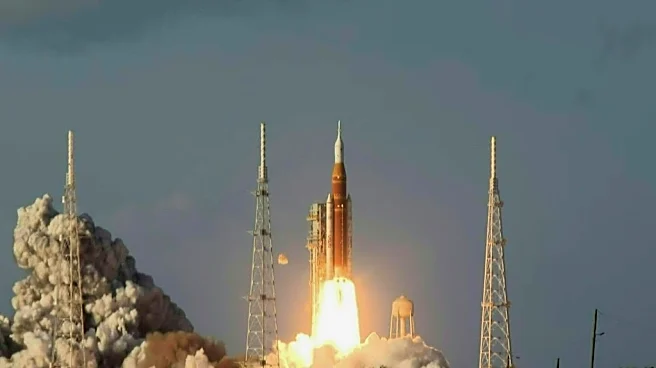
NASA's Artemis II mission, the first crewed test flight under the Artemis program, is currently underway. The mission involves four astronauts—Reid Wiseman, Victor Glover, Christina Koch, and Canadian Space Agency astronaut Jeremy Hansen—flying aboard
the Orion spacecraft around the Moon and back. The mission aims to test the spacecraft's systems in a deep space environment. The crew launched from Kennedy Space Center in Florida and is participating in various tests, including manual spacecraft operations and evaluations of life-support, propulsion, power, thermal, and navigation systems. The mission also includes lunar surface observations and human health studies. The Artemis II mission is a 10-day journey, with the spacecraft expected to travel a total of 695,081 miles, passing within 4,066 miles of the lunar surface at its closest approach.
Why It's Important?
The Artemis II mission is a critical step in NASA's efforts to return humans to the Moon and eventually send astronauts to Mars. By testing the Orion spacecraft's systems in a deep space environment, NASA aims to ensure the safety and reliability of future missions. The mission's success could pave the way for more advanced lunar exploration and the establishment of a sustainable human presence on the Moon. Additionally, the mission's scientific activities, including lunar surface observations, could lead to new discoveries and a better understanding of the Moon's features. The mission also serves as a demonstration of international collaboration, with the inclusion of a Canadian astronaut, highlighting the global interest in space exploration.
What's Next?
Following the completion of the Artemis II mission, NASA will analyze the data collected to inform future missions. The next major milestone in the Artemis program is Artemis III, which aims to land astronauts on the lunar surface. The success of Artemis II will be crucial in validating the systems and procedures needed for a safe lunar landing. NASA will continue to engage with international partners and the scientific community to refine mission plans and objectives. The agency will also focus on developing the necessary infrastructure and technology to support long-term lunar exploration and prepare for human missions to Mars.