







What's Happening?
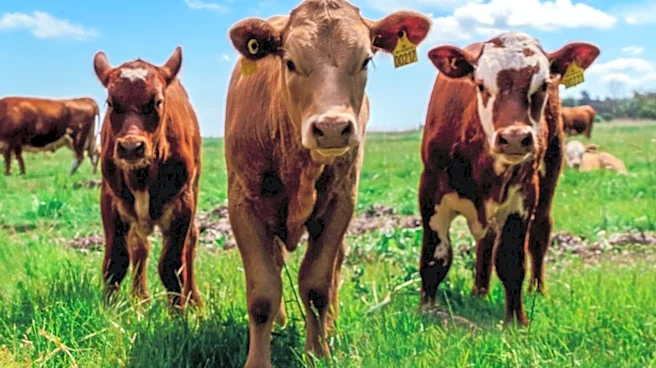
A new pre-print study indicates that organic beef farming is more environmentally harmful than conventional methods in terms of carbon emissions, water use, reactive nitrogen loss, and fossil fuel use. The research, which is not yet peer-reviewed, compared
organic beef farming, which relies on pasture grazing, with conventional beef production in confined feedlots. The most significant finding was that organic beef emitted 95% more carbon per kilogram of live cattle body weight produced compared to conventional production. This figure includes emissions from crop production for feed, farming equipment and fuel, and enteric methane emissions from the animals themselves. The study utilized 25 years of data from the New Mexico State University Clayton Livestock Research Center to simulate annual yields for both types of beef production.
Why It's Important?
This study challenges the common perception that organic farming is inherently more environmentally sustainable across all metrics, particularly concerning beef production. For U.S. consumers who often associate the "certified organic" label with environmental benefits, these findings could lead to a re-evaluation of their purchasing decisions and understanding of sustainable food choices. For the U.S. agricultural industry, the research highlights the complex environmental trade-offs between different farming practices and underscores the need for a more nuanced approach to sustainability. It suggests that simply switching to organic methods may not always yield the desired environmental outcomes, especially in terms of greenhouse gas emissions. The findings also reinforce broader reports from organizations like the World Resources Institute and the EAT-Lancet Commission, which advocate for reduced beef consumption in the Global North to curb greenhouse gas emissions and mitigate climate change impacts.
What's Next?
As a pre-print study, the research will undergo peer review, which may lead to further refinement or validation of its findings. If confirmed, these results could prompt a re-evaluation of environmental certifications and labeling standards for agricultural products, particularly within the beef industry. Consumers may become more discerning about the specific environmental impacts of their food choices, moving beyond general labels like "organic." For policymakers, the study could inform discussions on agricultural subsidies, environmental regulations, and strategies to reduce the carbon footprint of the livestock sector. The industry might also explore new innovations in both organic and conventional farming to address these environmental challenges, potentially focusing on feed additives to reduce methane emissions or more efficient land management practices. The ongoing global demand for food, coupled with the increasing awareness of agriculture's environmental impact, will continue to drive research and debate on sustainable food production methods.
Beyond the Headlines
This study delves into the intricate relationship between food production systems and their environmental consequences, revealing that solutions are rarely black and white. It highlights the complexity of assessing sustainability, where different metrics (e.g., carbon emissions vs. pesticide use) can lead to conflicting conclusions about which practices are "better." The findings could spark a broader conversation about the efficacy of current organic standards and whether they adequately address all aspects of environmental impact, particularly climate change. It also underscores the challenge of balancing consumer expectations, farmer livelihoods, and ecological imperatives. The study implicitly suggests that a holistic approach, considering the entire lifecycle and various environmental factors, is necessary for truly sustainable agriculture. This could lead to the development of more comprehensive sustainability metrics and certifications that provide consumers with a clearer understanding of the environmental footprint of their food choices.