





What's Happening?
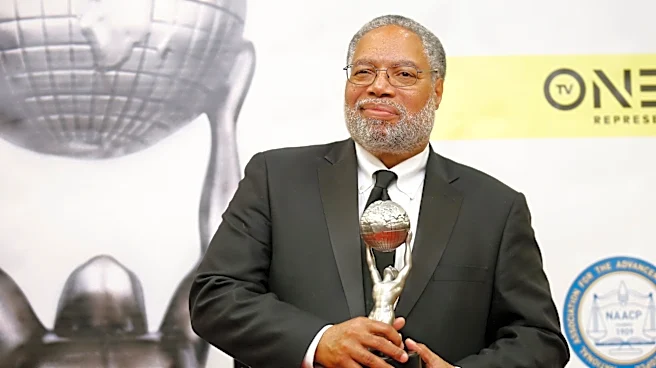
Lonnie Bunch is stepping down from his role as Secretary of the Smithsonian Institution at the end of the year, following a period of tension with the Trump administration. Since 2019, Bunch has led the Smithsonian, but his tenure has been marked by the administration's
efforts to influence the portrayal of U.S. history by the Smithsonian museums and other cultural entities. A White House report two months prior to Bunch's announcement criticized the leadership of the Smithsonian Institution, particularly at the National Museum of American History, labeling them as 'radical activists' and questioning their ability to present history in an 'inspiring, unifying, and worthy' manner. This report led to President Trump ordering signs to be installed at the U.S. history museum, informing visitors that some exhibits were inaccurate. Anthea M. Hartig, the director of the National Museum of American History, publicly challenged these claims during congressional hearings, asserting that the report did not accurately characterize the museum's work. The Trump administration has been scrutinizing the Smithsonian since 2025, focusing on the images and messages presented to the public as the nation approaches its 250th anniversary, with a March 2025 executive order, 'Restoring Truth and Sanity to American History,' leading to changes in federal parks and museum exhibits.
Why It's Important?
The departure of Lonnie Bunch from the Smithsonian Institution highlights a significant conflict over the interpretation and presentation of American history within national cultural institutions. This situation underscores the broader political and cultural debates in the U.S. regarding historical narratives and their role in national identity. The Trump administration's direct intervention, including a White House report and orders to alter museum signage, represents an unprecedented level of executive branch involvement in the curatorial independence of the Smithsonian. This could set a precedent for future administrations to exert influence over cultural institutions, potentially leading to politicized historical interpretations. The controversy also brings to light the vulnerability of non-executive branch institutions like the Smithsonian to political pressure, despite their independent oversight structures. The outcome of this clash could impact how historical events are taught and understood by the public, influencing national discourse and potentially shaping educational policies and funding for cultural programs. The debate over 'inspiring, unifying' history versus a more critical and comprehensive historical account reflects deep divisions within American society.
What's Next?
Following Lonnie Bunch's retirement, the Board of Regents, which includes Vice President JD Vance and Supreme Court Chief Justice John Roberts, will be tasked with selecting a new Secretary for the Smithsonian Institution. This appointment will be closely watched, as it will indicate the future direction of the institution's historical interpretations and its relationship with the executive branch. Tony Johnson, membership director of the Heritage Foundation, has stated that his organization will advocate for a new Secretary who will not treat the Smithsonian as a 'culture-war battleground,' suggesting continued scrutiny from conservative groups. Conversely, California Democrat Sen. Alex Padilla has praised Bunch for defending American history and values against the Trump administration's attacks, emphasizing the importance of the Board of Regents and Congress in ensuring the continuity of Bunch's work. The Smithsonian's ongoing review, ordered by the White House, of all public-facing content to 'assess tone, historical framing, and alignment with American ideals' will likely continue, influencing exhibition content and educational materials across its various museums. Bunch is scheduled to speak at the National Museum of African American History and Culture on September 25, an event that may offer further insights into his perspective on these developments.
Beyond the Headlines
The conflict surrounding Lonnie Bunch's departure extends beyond immediate political disagreements, touching upon fundamental questions of historical truth, academic freedom, and the role of national institutions in shaping public memory. The Trump administration's push for a specific, 'inspiring' narrative of U.S. history raises concerns about historical revisionism and the suppression of diverse perspectives. This situation highlights the delicate balance between governmental oversight and the intellectual independence of cultural and educational bodies. The long-term implications could include a chilling effect on critical historical scholarship and exhibition development if institutions fear political repercussions for presenting narratives that challenge dominant viewpoints. Furthermore, the debate over what constitutes 'American ideals' in historical context reflects a broader societal struggle to reconcile past injustices with national pride. This episode could also influence public trust in national museums as impartial custodians of history, potentially leading to increased polarization in how historical events are perceived and discussed by different segments of the population. The outcome will likely shape the future of historical interpretation in public spaces for generations.