







What's Happening?
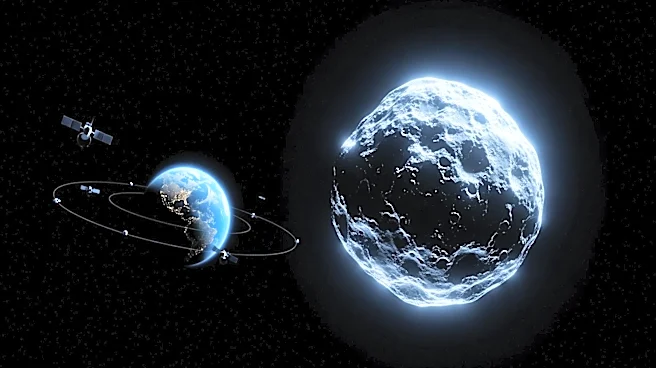
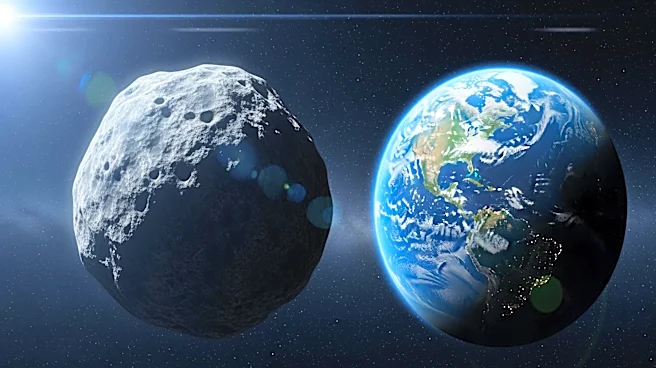
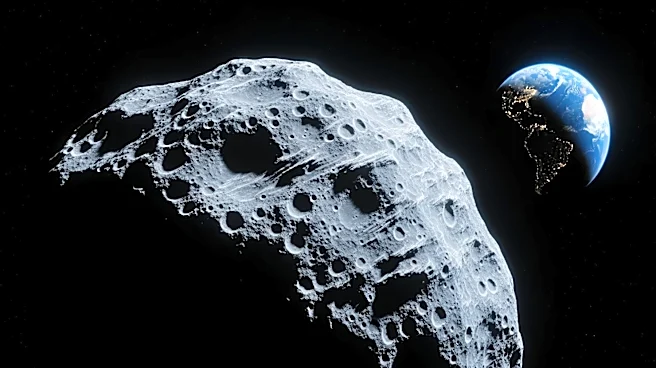
A newly discovered asteroid, designated 2026 JH2, is set to make a close approach to Earth on May 18, 2026. The asteroid, which is comparable in size to an adult blue whale, was discovered by the Mount Lemmon Survey in Arizona on May 10, 2026. It is estimated
to measure between 52 and 114 feet in diameter. During its closest approach, 2026 JH2 will pass within 56,628 miles of Earth, traveling at a speed of 19,417 mph. The Virtual Telescope Project will provide a live stream of the event, allowing viewers to watch the asteroid as it moves rapidly against the starry background. The asteroid poses no threat to Earth or the moon during this flyby, and it will be visible as a bright dot of light through telescopes.
Why It's Important?
The close approach of asteroid 2026 JH2 presents a valuable opportunity for astronomers and the public to observe a near-Earth object in real-time. Such events are crucial for scientific research, as they allow for the study of asteroid trajectories, compositions, and potential impact risks. Understanding these factors is essential for developing strategies to mitigate potential future threats from larger asteroids. Additionally, public engagement through live streams can raise awareness about space science and the importance of monitoring near-Earth objects. This event highlights the ongoing efforts of astronomers to track and study celestial bodies that come close to our planet.
What's Next?
Following its close approach, asteroid 2026 JH2 will continue on its elliptical orbit, venturing near Jupiter before returning towards the sun. Its next close pass by Earth is not expected until the year 2060, when it will pass at a much greater distance. In the meantime, astronomers will continue to monitor its trajectory and gather data to refine predictions about its future movements. The Virtual Telescope Project and other observatories will likely continue to provide public access to similar events, fostering interest and education in space science.