





What's Happening?
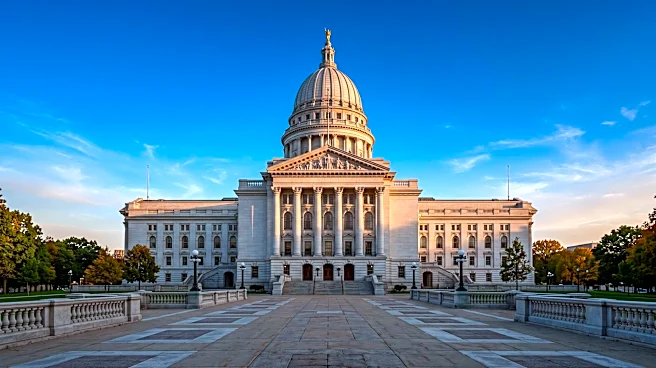
Wisconsin Democrats are aiming to gain control of both the State Assembly and Senate in the upcoming November elections, a goal that seemed improbable just a few years ago. This renewed optimism stems from a 2023 ruling by Wisconsin’s newly liberal State Supreme
Court, which declared the Republican-drawn legislative maps unconstitutional and mandated their replacement. These previous maps had been criticized as a prime example of undemocratic gerrymandering, allowing Republicans to maintain power despite Democrats winning a majority of votes in some elections. Following the acceptance of new maps proposed by Governor Tony Evers, Democrats made significant gains in 2024, leaving them only two seats shy of a State Senate majority and five in the House.
Why It's Important?
The potential shift in legislative control in Wisconsin holds significant implications for the state's political landscape and could serve as a model for other states grappling with gerrymandering. A Democratic trifecta—control of the governorship, State Assembly, and State Senate—would enable a pivot away from policies characterized by tax cuts, weakened labor unions, and voter restrictions. This change could lead to new legislative priorities, potentially impacting areas such as education, healthcare, and environmental regulations. Furthermore, if Democrats gain control, they would have the power to redraw congressional maps for 2028, which could counter Republican gerrymandering efforts in other parts of the country and influence the national political balance. This development underscores the critical role of state supreme courts in upholding democratic principles and ensuring fair representation.
What's Next?
The upcoming November elections in Wisconsin will be a crucial test for the Democrats' ability to capitalize on the new legislative maps and secure a trifecta. Intense field organizing and voter engagement efforts are expected from both parties. If Democrats succeed, they will likely pursue a legislative agenda that reflects their priorities, potentially reversing some of the policies enacted under Republican control. The redrawing of congressional maps in 2028 will be a significant future step, with national implications for the balance of power in the U.S. House of Representatives. Conversely, if Democrats fall short, the state's political landscape could remain divided, leading to continued legislative stalemates and ongoing debates over policy direction. The outcome will also be closely watched by political strategists nationwide as a case study in the impact of judicial intervention on electoral fairness.
Beyond the Headlines
The Wisconsin situation highlights a broader national struggle over electoral fairness and the impact of partisan gerrymandering on democratic representation. The State Supreme Court's ruling represents a significant victory for advocates of fair maps, demonstrating the judiciary's power to intervene when legislative processes are deemed unconstitutional. This development could inspire similar legal challenges in other states where gerrymandering has entrenched one party's power. Ethically, the case raises questions about the integrity of electoral systems and the extent to which political parties should be allowed to manipulate district boundaries for partisan gain. Culturally, it reflects a growing public demand for more equitable and representative governance, potentially leading to increased civic engagement and calls for electoral reform across the country.