


What's Happening?
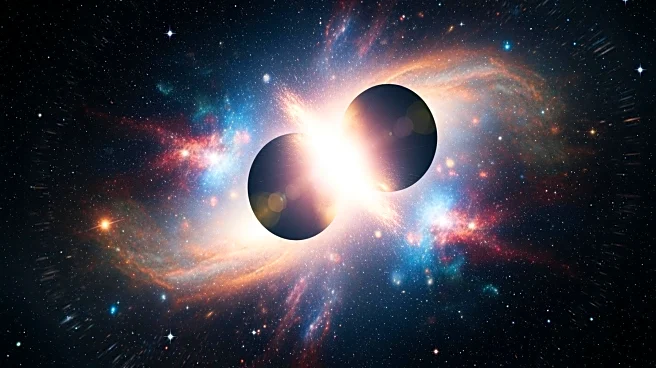
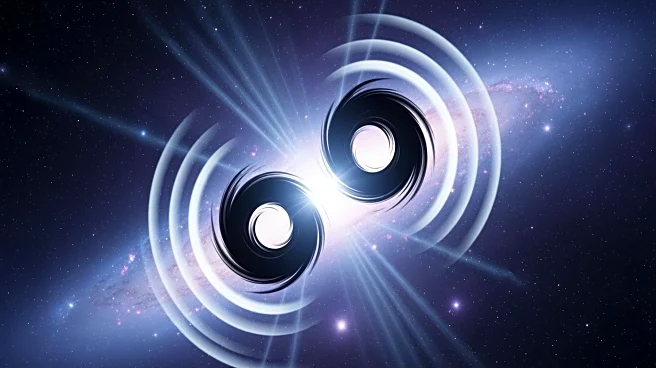
Astronomers have observed a blaze of gamma and X-ray light following the collision of two black holes, detected by LIGO-Virgo-KAGRA in November 2024. This event, named S241125n, occurred in the accretion disk of a supermassive black hole within a host
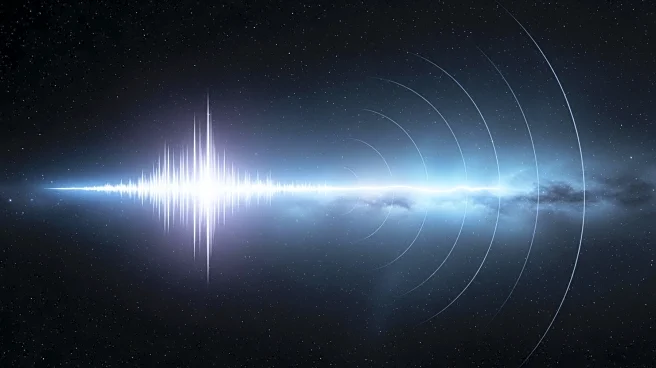
galaxy's active galactic nucleus. The collision produced gravitational waves and a subsequent flash of light, challenging the typical expectation that black hole mergers are dark. The researchers propose that the collision triggered rapid accretion, launching jets that produced the observed gamma-ray burst.
Why It's Important?
This discovery is significant as it suggests that under certain conditions, black hole mergers can produce detectable light, offering new insights into the dynamics of galactic centers and the behavior of black holes. Understanding these phenomena could enhance our knowledge of gravitational waves and electromagnetic signals, potentially revealing new connections between these cosmic events. The findings may also inform future studies on the role of black hole mergers in the broader cosmic landscape, contributing to the understanding of galaxy formation and evolution.
What's Next?
Further studies are needed to confirm the hypothesis that black hole collisions in accretion disks can produce light. Researchers may conduct deep-field observations of host galaxies to test the proposed model and explore similar events. Future investigations could provide deeper insights into the fundamental physics of black hole mergers and their impact on galactic environments. Continued monitoring and analysis of gravitational wave signals and electromagnetic counterparts will be crucial in advancing this area of astrophysics.