
What's Happening?
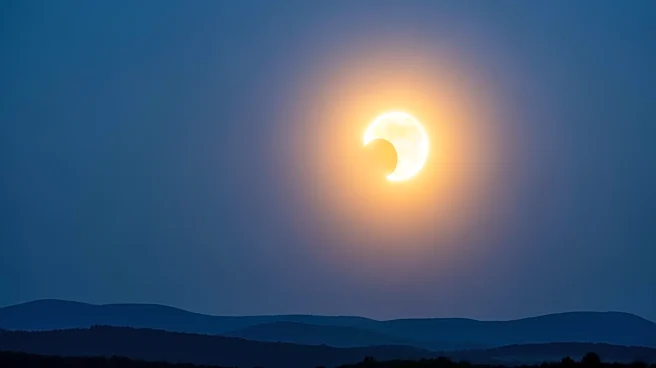
From August 2026 through July 2028, Earth will experience a series of six solar eclipses, including three total solar eclipses and three annular 'ring of fire' eclipses. This period marks a rare opportunity
for eclipse enthusiasts, with total solar eclipses occurring in August 2026, August 2027, and July 2028. The path of totality for these eclipses will cover diverse regions, including Europe, North Africa, the Middle East, and the Australian Outback. The 2027 eclipse, dubbed the 'eclipse of the century,' will offer a long duration of totality and will be visible from historic sites like Luxor, Egypt. The annular eclipses will also provide unique viewing experiences, with paths crossing remote and scenic locations.
Why It's Important?
This series of eclipses presents significant opportunities for scientific observation and public engagement with astronomy. The events are expected to draw large numbers of tourists and eclipse chasers, boosting local economies in the regions along the paths of totality. The eclipses also offer educational opportunities, raising public awareness and interest in astronomy and space science. For many, witnessing a total solar eclipse is a once-in-a-lifetime experience, and this period provides multiple chances to observe this natural phenomenon.
What's Next?
As the dates for these eclipses approach, preparations will intensify in the regions expecting high numbers of visitors. This includes planning for infrastructure, accommodation, and public safety. Travel companies and tour operators are likely to offer specialized eclipse viewing packages, and scientific communities will prepare for data collection and research opportunities. Public outreach and education campaigns will aim to maximize the educational impact of these events.