
What's Happening?
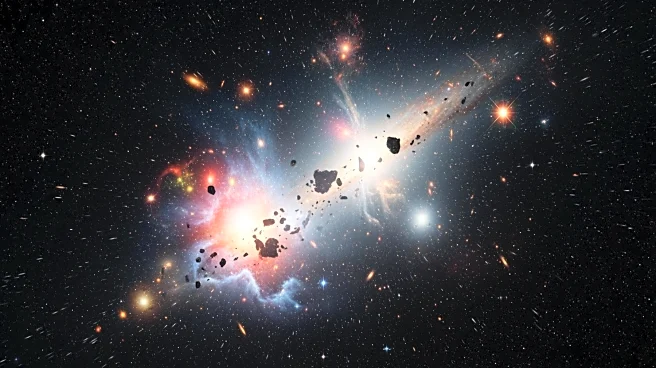
NASA's Hubble Space Telescope has provided a rare glimpse into the aftermath of two cosmic collisions near the star Fomalhaut. Initially, a dense, bright spot observed near Fomalhaut was thought to be
a planet. However, recent images from Hubble revealed that the spot had vanished, replaced by a new one, indicating it was not a planet but rather the result of massive space rocks colliding. These collisions created clouds of dust that were thick enough to appear as planets. The space rocks involved were at least 37 miles wide, and such events are theorized to occur in the same vicinity only once every 100,000 years. The findings, published in the journal Science, suggest that these collisions might be more common than previously thought.
Why It's Important?
The observations by Hubble are significant as they provide insights into the processes that shaped our solar system. Collisions of large space rocks are crucial to understanding how planets form and what they are composed of. The ability to capture such events in real-time allows scientists to study the dynamics of planetary formation and the conditions that lead to such collisions. This research could lead to a better understanding of the early solar system's violent history and the frequency of such events, potentially altering existing theories about planetary formation.
What's Next?
Researchers plan to continue monitoring the new dust cloud to observe its changes and eventual disintegration. This ongoing observation will help scientists gather more data on the frequency and nature of such cosmic collisions. The star Fomalhaut, located just 25 light-years from Earth, will remain a focal point for future studies, as scientists aim to catch more of these violent explosions in real-time.