
What's Happening?
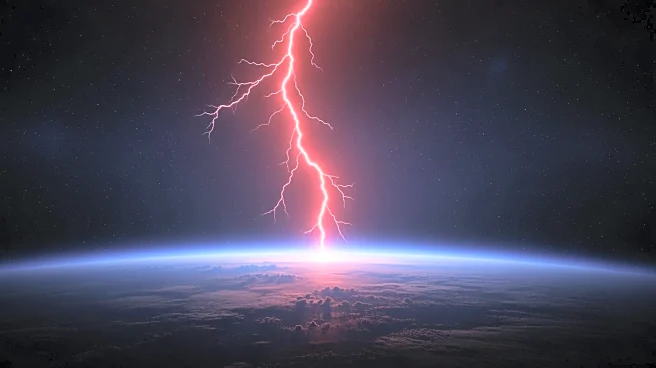
Astronaut Nichole Ayers aboard the International Space Station (ISS) captured a rare atmospheric phenomenon known as a 'sprite' above a thunderstorm. Sprites are short-lived bursts of red light that occur
in Earth's upper atmosphere during thunderstorms, triggered by intense lightning strikes. Unlike typical lightning, sprites shoot upward from the tops of thunderclouds, reaching altitudes of about 50 miles above the Earth's surface. These events are part of a broader class of phenomena called Transient Luminous Events (TLEs), which include blue jets and elves. Observing sprites from space provides researchers with data that cannot be obtained from ground-based observations, offering a clear view of the upper atmosphere. This particular sprite was observed over Mexico and the U.S., alongside the artificial light from cities below.
Why It's Important?
The observation of sprites from the ISS is significant for atmospheric research, as it provides insights into the formation and characteristics of TLEs, which are not fully understood. This data is crucial for understanding the relationship between thunderstorms and these luminous events. The ability to study sprites from space allows scientists to gather information that is otherwise inaccessible from the ground, enhancing our understanding of atmospheric phenomena. This research could lead to advancements in weather prediction and a better understanding of the Earth's electrical environment, potentially impacting fields such as aviation safety and climate science.
What's Next?
Future research will likely focus on analyzing the data collected from these observations to further understand the mechanisms behind sprite formation. Scientists may use this information to develop models that predict the occurrence of TLEs, contributing to improved weather forecasting. Additionally, the continued use of the ISS as a platform for observing atmospheric phenomena will provide ongoing opportunities for discovery and collaboration among international researchers.