






What's Happening?
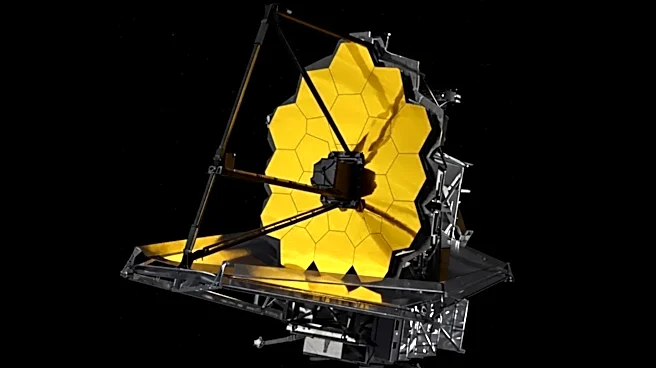
A new privately funded space telescope, the Lazuli Space Telescope, backed by former Google CEO Eric Schmidt, is being developed with a launch target of 2029. This observatory will feature a 3-meter primary mirror, exceeding the 2.4-meter mirror of the Hubble
Space Telescope. A recent study has identified 27 giant exoplanets as prime targets for Lazuli's specialized ExtraSolar Coronagraph (ESC). This instrument is designed to suppress the overwhelming glare of host stars, allowing astronomers to directly observe much fainter planets by detecting starlight reflected by their atmospheres. This method differs from previous direct imaging techniques, which primarily relied on the thermal radiation emitted by young, hot exoplanets. The research, conducted by Logan Pearce of the University of Michigan and Ewan Douglas of the University of Arizona, focuses on known exoplanets with well-constrained orbits to maximize observation efficiency.
Why It's Important?
The Lazuli Space Telescope represents a significant advancement in exoplanet research, particularly in its ability to study older, colder planetary systems. By detecting reflected starlight, Lazuli can characterize planets whose thermal emissions have diminished over billions of years, opening a new window into the composition and evolution of mature exoplanet atmospheres. This capability will allow scientists to investigate a broader range of planetary populations, providing crucial data for comparative planetology and understanding how giant planets change over time. The private funding model also signifies a growing trend in major astronomical infrastructure, potentially offering new avenues for accelerating scientific missions outside traditional government agency programs. The mission could also refine techniques relevant to future investigations of potentially habitable worlds by studying atmospheric biosignatures.
What's Next?
The Lazuli Space Telescope is slated for launch by 2029. Following its deployment, the mission will focus on its proposed observing campaign targeting the 27 selected giant exoplanets. The success of these observations will depend on the telescope achieving its designed performance, particularly the effectiveness of its ExtraSolar Coronagraph in suppressing stellar glare. Data collected by Lazuli will be combined with observations from other facilities, such as the Nancy Grace Roman Space Telescope and the Extremely Large Telescope (ELT), to provide a more comprehensive picture of exoplanet atmospheres across different wavelength ranges. The project's progress will also be closely watched as a case study for the viability and impact of privately financed orbital observatories in advancing astronomical research.
Beyond the Headlines
The Lazuli Space Telescope's approach of using reflected starlight to study exoplanets marks a paradigm shift in direct imaging capabilities. This method decouples detection from a planet's age, allowing for the characterization of mature planetary systems that more closely resemble our own. The ethical and scientific implications of studying a wider array of exoplanet atmospheres are profound, potentially revealing new insights into planetary formation, atmospheric chemistry, and the conditions necessary for life. The emergence of privately funded observatories like Lazuli also raises broader questions about the future of space exploration, including the potential for increased innovation, faster development cycles, and new collaborative models between public and private entities in scientific endeavors. This could reshape how major astronomical projects are conceived, funded, and executed in the coming decades.