


What's Happening?
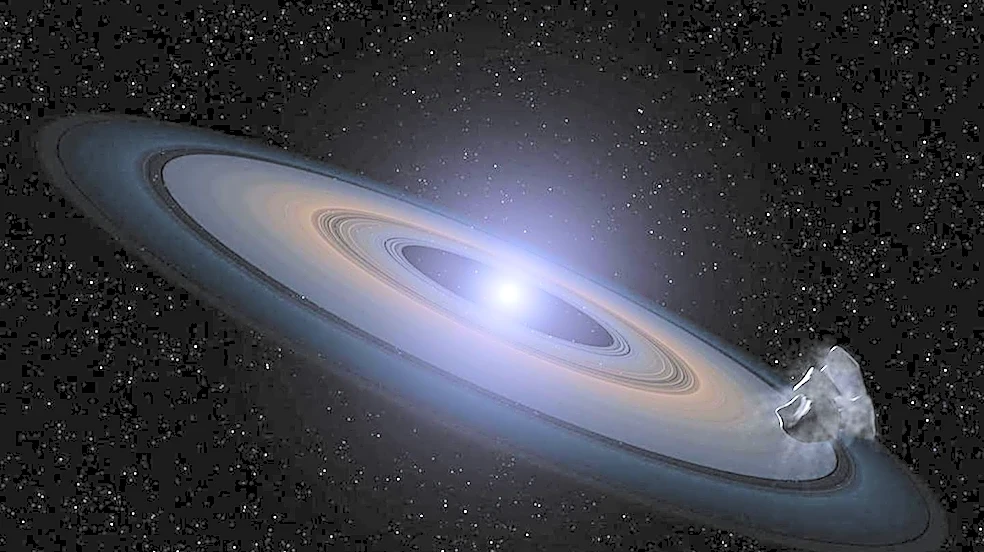
Astronomers have for the first time identified a green star, named WD J1330+6435, which is a white dwarf located approximately 280 light-years from Earth in the constellation Draco. This unique chartreuse glow is attributed to the white dwarf ingesting
rocky debris from planets that once orbited it. The debris enriched its outer layers with elements like calcium, lithium, and notably, sodium. Unlike normal stars where sodium absorbs a narrow orange wavelength, the extreme density of this white dwarf causes helium atoms to bombard sodium atoms, altering their energy levels. This results in the sodium absorbing a broader spectrum of yellows, oranges, and some red wavelengths, leaving behind a distinct green hue. This discovery was part of a project by the University of Warwick assessing how human eyes would perceive the colors of white dwarfs.
Why It's Important?
This discovery significantly advances our understanding of white dwarf atmospheric compositions and the long-term fate of planetary systems. It provides direct evidence of planetary material being accreted onto a stellar remnant, offering insights into the chemical evolution of dead stars and the debris disks that surround them. The unique spectral absorption mechanism observed in WD J1330+6435 challenges conventional astrophysical models of stellar color and atmospheric physics, particularly for high-density environments. This research contributes to the broader field of exoplanetary science by demonstrating how the remnants of planetary systems can leave detectable chemical signatures on their host stars, potentially aiding in the identification of other post-main-sequence planetary systems.
What's Next?
Researchers will likely continue to study WD J1330+6435 and other white dwarfs to further understand the processes of planetary debris accretion and its impact on stellar atmospheric chemistry. This could involve more detailed spectroscopic analyses to identify other elements and their absorption properties. The methodology used to assess white dwarf colors, including the development of white dwarf spectrum models and the use of data from the Sloan Digital Sky Survey, will likely be applied to a larger sample of white dwarfs to identify more stars with unusual colorations. This could lead to a more comprehensive classification of white dwarf colors based on their atmospheric compositions, revealing more 'salmon pink' or 'cyan' stars and expanding our knowledge of stellar diversity.
Beyond the Headlines
The identification of a green star, a phenomenon previously confined to science fiction, underscores the universe's capacity for unexpected and complex phenomena. It highlights the dynamic interplay between stars and their planetary systems, even after the star's life cycle has seemingly ended. This discovery could inspire new theoretical work on the chemical and physical processes occurring in extreme stellar environments, potentially leading to a deeper appreciation of the intricate mechanisms that govern cosmic evolution. Furthermore, it serves as a reminder that the universe often surpasses human imagination, offering continuous opportunities for groundbreaking scientific exploration and challenging our preconceived notions of what is possible.