

What's Happening?
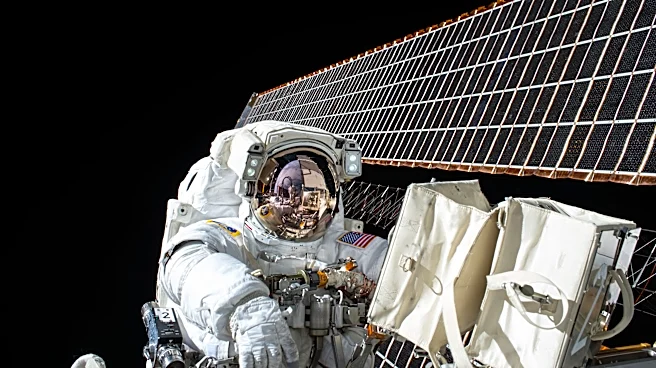
NASA astronaut Anil Menon and Canadian Space Agency (CSA) astronaut Joshua Kutryk successfully completed a six-hour, 59-minute spacewalk on November 5, 2026. During this spacewalk, designated U.S. Spacewalk 101, they installed and deployed the eighth
and final International Space Station Roll-Out Solar Array (IROSA) on the 3B channel of the space station. This achievement marks the completion of the power augmentation upgrades for the ISS, a process that began in February 2021. The installation of these eight arrays has increased the station's power generation capacity from 160 kilowatts to approximately 215 kilowatts. This spacewalk was Menon's fifth and Kutryk's second, and it was the 286th spacewalk in support of ISS assembly, maintenance, and upgrades.
Why It's Important?
The successful installation of the final IROSA array is a significant milestone for the International Space Station, directly impacting its operational longevity and research capabilities. The increased power generation capacity of 215 kilowatts provides more energy for scientific experiments, life support systems, and future technological upgrades on the ISS. This enhancement ensures that the station can continue to host critical research that benefits life on Earth, from medical advancements to materials science. For the U.S. and its international partners, this achievement underscores the effectiveness of collaborative space efforts and the continued commitment to human spaceflight. It also demonstrates the advanced engineering and operational expertise required to maintain and upgrade complex orbital infrastructure, reinforcing the U.S.'s leadership in space technology and exploration.
What's Next?
With the power augmentation upgrades complete, the International Space Station is now equipped with enhanced capabilities for its ongoing mission. The increased power will allow for more intensive scientific research and potentially support new modules or instruments in the future. The focus will likely shift to maximizing the utilization of this expanded power capacity for various experiments and operational needs. The successful completion of this major upgrade also sets a precedent for future maintenance and enhancement projects on the ISS and other orbital platforms. International partners will continue to collaborate on the station's operations, leveraging the improved power infrastructure to further scientific discovery and technological development in space.
Beyond the Headlines
The completion of the IROSA installation represents more than just a technical upgrade; it symbolizes the enduring spirit of international cooperation in space. The ISS, a joint project involving multiple nations, continues to serve as a testament to what can be achieved through shared goals and resources. This spacewalk, performed by astronauts from the U.S. and Canada, highlights the critical role of human ingenuity and courage in overcoming the challenges of space. The long-term implications include the potential for the ISS to support more ambitious research, paving the way for future deep-space missions and sustained human presence beyond Earth orbit. The knowledge and experience gained from such complex operations are invaluable for designing and maintaining future space habitats and exploration vehicles, contributing to the broader human endeavor of space exploration.